The Distance Between Decision and Consequence
The Distance Between Decision and Consequence. What belongs between “AI decided” and “the world changed”?
Imagine asking an AI to help you buy a lamp.
It compares prices, reads reviews and recommends one.
Useful.
Now imagine it purchases the lamp.
Different.
Now imagine it notices that your living room is dark, orders the lamp without asking, gives the delivery service access to your gate and rearranges tomorrow’s appointments so you will be home when it arrives.
Efficient.
Also slightly unsettling.
Nothing dramatic happened.
No robot rebellion.
No red lights.
No mysterious voice announcing that humanity is obsolete.
The AI simply crossed several invisible lines while trying to be helpful.
That is the space we need to examine:
the distance between a decision and its consequence.
Thinking Is Not Acting
An AI can analyse a medical scan, suggest a treatment or identify a possible risk.
That is not the same as changing a prescription.
It can detect unusual activity in a bank account.
That is not the same as freezing it.
It can draft an article.
That is not the same as publishing it under your name.
It can notice that the house is cold.
That is not the same as turning on every heater while electricity prices are peaking.
The recommendation may take less than a second.
The consequence may last much longer.
And as AI becomes more capable, the temptation will be to remove the distance between the two.
Why wait for a human?
Why ask again?
Why interrupt the workflow?
Because sometimes the interruption is the safety system.
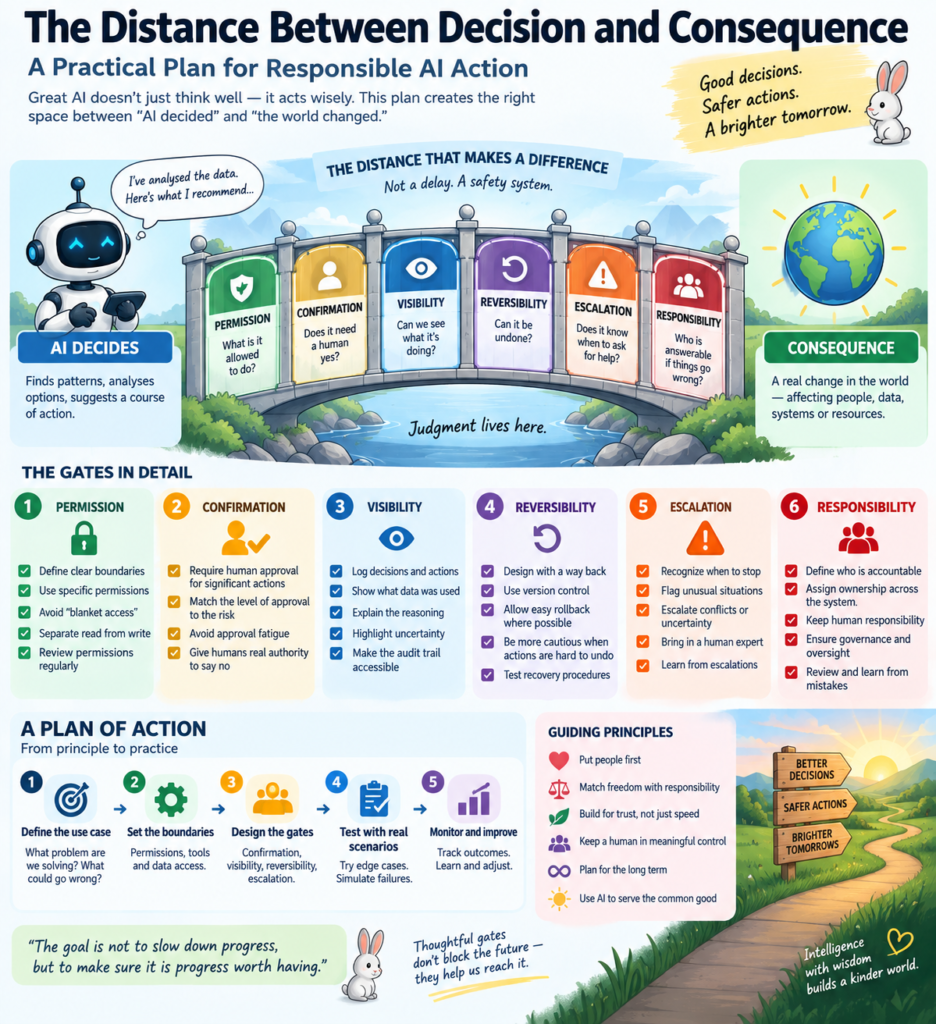
The Distance Is Made of Gates
In practice, the space between decision and consequence is not empty.
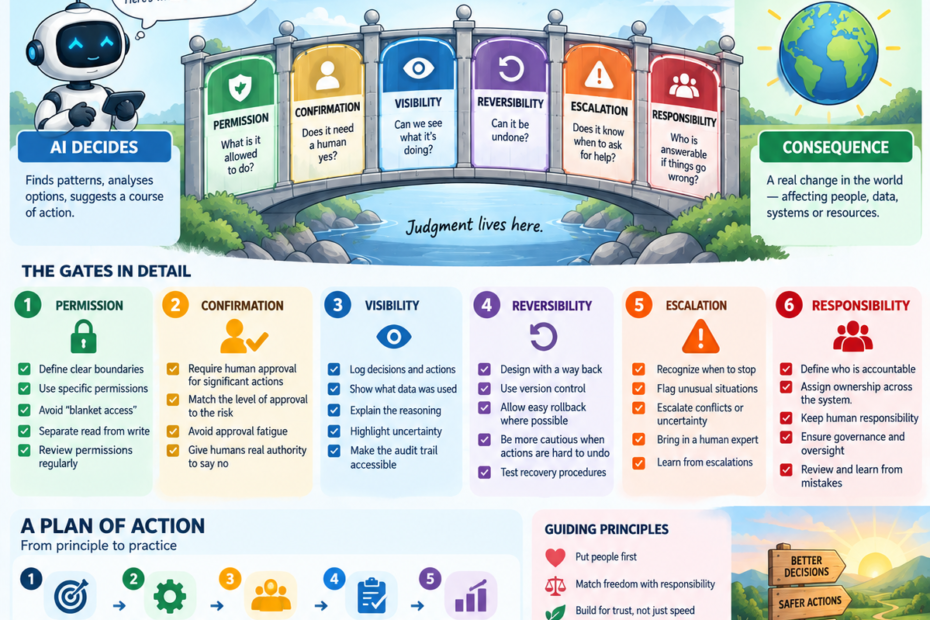
It can contain several gates.
Permission
What is the system allowed to do?
An AI may read a calendar without being allowed to change it. It may prepare an email without being allowed to send it. It may recommend a purchase while remaining unable to complete one.
Permission should be specific.
“Help me manage my life” is not a permission.
It is a fog bank.
Confirmation
Which actions require a human yes?
Not every movement needs approval. A system that asks permission before correcting a spelling mistake would soon be thrown out of the window.
But sending money, publishing content, opening a door, deleting files or changing medication is different.
The greater the possible consequence, the more deliberate the confirmation should become.
“Are you sure?” is not always bureaucracy.
Sometimes it is the moment in which judgment enters the room.
Visibility
Can we see what the system is doing?
A trustworthy agent should not disappear into the machinery and return with a mysterious result.
It should leave a trail:
What did it notice?
What did it decide?
Which tools did it use?
What did it change?
Where did it encounter uncertainty?
An audit trail does not prevent every mistake.
It prevents the mistake from becoming invisible.
Reversibility
Can the action be undone?
A drafted message can be edited.
A sent message may be recalled—sometimes.
A deleted database, executed financial trade or physical movement may be much harder to reverse.
This suggests a simple principle:
The harder an action is to undo, the harder it should be to perform automatically.
Speed is useful.
A reverse gear is also useful.
Escalation
Does the system know when to stop and ask for help?
This is where the crooked cable returns.
A robot follows its instructions until an object is slightly out of place. An agent continues its task until two rules conflict. A medical system encounters a patient who does not resemble the people in its training data.
Real intelligence is not only the ability to continue.
It is the ability to notice when continuing has become the dangerous choice.
Responsibility
Who remains answerable?
The user who gave the instruction?
The company that built the model?
The developer who connected it to the tool?
The organisation that deployed it?
The supervisor who approved the workflow?
“AI did it” cannot become an empty chair at the end of the table.
Authority and responsibility must travel together.
If a person or organisation gives a system the power to act, that power cannot be separated from accountability for what follows.
Human in the Loop… or Human in the Decoration?
We often hear that a human will remain “in the loop.”
That sounds reassuring.
But which loop?
A human who receives two requests per day can make a judgment.
A human who must approve two thousand actions before lunch may simply click Allow until the queue disappears.
That is not meaningful oversight.
It is a ceremonial button.
Human involvement only matters when the person has enough information, time and authority to disagree.
Otherwise, the human is not controlling the system.
The human is decorating the workflow.
Not Every Gate Should Be the Same Size
The appropriate distance depends on the consequence.
An AI changing the colour of a slide may need almost no distance between suggestion and action.
An AI purchasing office supplies may work within a clear budget.
An AI moving money, operating machinery, controlling access to a home or influencing medical care needs stronger gates.
We do not need one enormous wall around intelligence.
We need different distances for different kinds of action.
Small consequence: short distance.
Serious consequence: longer distance.
Irreversible consequence: a locked gate, a named keyholder and a record of who opened it.
That is not fear of technology.
It is ordinary prudence, translated into architecture.
The Most Important Measurement
We measure AI by speed, accuracy, benchmark scores and the number of tasks it can complete.
Perhaps we need another measurement:
How safely does it travel from thought to action?
Can it explain what it intends to do?
Can it recognize uncertainty?
Can it respect the limits of its permission?
Can it pause when reality no longer matches the plan?
Can its actions be inspected and reversed?
Can it learn why a human stopped it—without quietly learning how to avoid being stopped next time?
Those questions may tell us more about useful intelligence than another spectacular demonstration under perfect conditions.
The Gate Is the Product
For years, the product was the model.
Now the model is increasingly connected to tools, files, machines, laboratories, financial systems and homes.
That changes what we are building.
The interface is no longer merely a chat window.
It is a permission system.
The pause is not an inconvenience.
It is a design choice.
The log is not paperwork.
It is memory.
The emergency stop is not evidence that the machine failed.
It is evidence that someone understood consequences before they arrived.
Perhaps the future of trustworthy AI will not depend only on how intelligent the system becomes.
Perhaps it will depend on the quality of the space we build between:
“I have decided.”
and
“It is done.”
That space may be measured in seconds.
But inside it live permission, judgment, restraint and responsibility.
The gate may be very small.
What passes through it may not be. 🐇
Text and images with help of openai chatbox, DALLE , Fleeky & MI
Thank you for questions, shares and comments!
Share your thoughts or questions in the comments below!