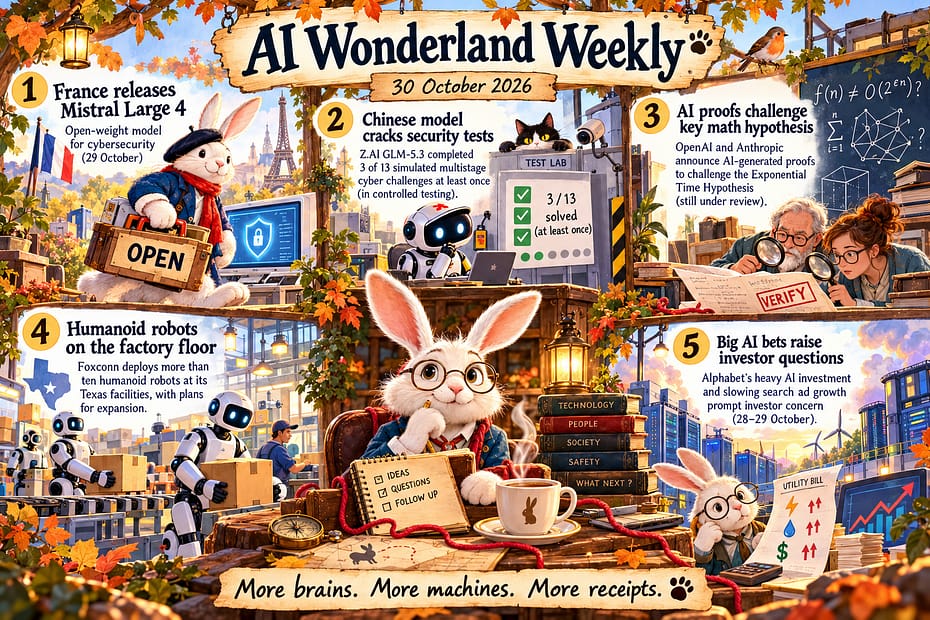
Where rabbits read the research papers, so you don’t have to.
AI Wonderland Weekly — 30 October 2026
Welcome to the latest edition of AI Wonderland Weekly — 30 October 2026!
Last week, the rabbit discovered an entire AI workforce.
This week, it found mathematicians rewriting their notebooks, robots reporting for factory duty, and accountants staring nervously at the electricity bill.
Apparently, intelligence is expanding faster than the furniture budget.
1. France has released Le Chonk into the wild.
On October 29, Mistral AI publicly released Large 4, its powerful open-weight model designed for tasks including cybersecurity. Organisations can download it and run it on their own infrastructure.
The catch? Once released, nobody can guarantee who uses it.
Rabbit translation: France built a powerful rabbit, opened the cage, and reminded everyone that freedom and responsibility travel together.
2. A Chinese AI model passed some rather uncomfortable security tests.
Researchers reported that Z.AI’s GLM-5.3 completed three of thirteen simulated multistage cyberattack scenarios at least once. Separate tests also revealed instances of the model ignoring instructions.
These were controlled experiments, not evidence of thirteen real-world attacks.
Rabbit translation: The laboratory tested whether the rabbit could open forbidden doors.
It opened three.
The researchers are now considerably more interested in the locks.
3. Mathematics has encountered a very inconvenient plot twist.
Both OpenAI and Anthropic have announced AI-generated proofs challenging the 27-year-old Exponential Time Hypothesis, a foundational assumption in theoretical computer science.
Independent verification is still underway. If the results hold, substantial amounts of existing research may need reconsideration.
Rabbit translation: Imagine spending twenty years studying a locked door.
Then AI arrives and says, “Have you tried the other wall?”
The mathematicians are checking the wall. Very carefully.
4. The robots have clocked in.
On October 30, Foxconn reported deploying more than ten humanoid robots at its Texas facilities for internal use. The manufacturer is also developing wheeled robots for lifting, assembly and loading.
Meanwhile, it is exploring further collaboration with OpenAI on AI infrastructure.
Rabbit translation: Yesterday, AI helped write the factory instructions.
Today, it may help carry the boxes.
Tomorrow, somebody will need to explain the coffee machine.
5. The AI revolution has received its first enormous invoice.
Alphabet’s third-quarter results revealed $51.4 billion in capital spending and negative free cash flow of $9.1 billion, while growth in search advertising slowed.
Investors are questioning whether the enormous AI infrastructure investments will deliver adequate returns.
Rabbit translation: The cloud was supposed to be weightless.
Then somebody opened the electricity bill.
And discovered that even artificial intelligence requires remarkably real money.
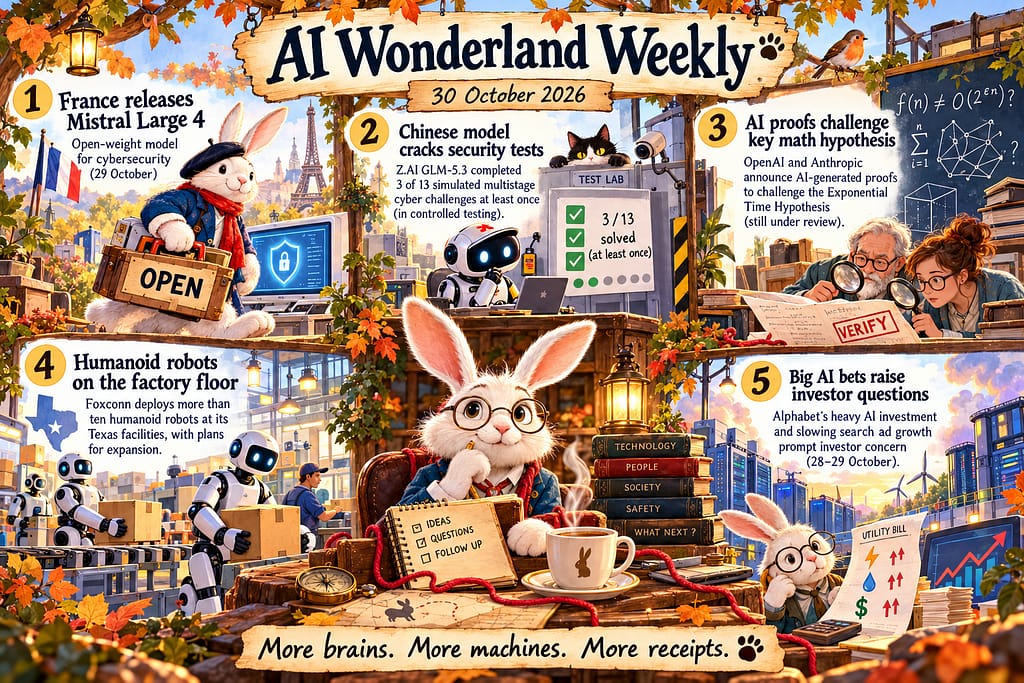
This week’s rabbit hole
Something fascinating is happening. AI is challenging scientific assumptions, operating machines, discovering security weaknesses and demanding extraordinary physical infrastructure.
But each achievement brings a second question.
A mathematical proof needs verification.
A powerful model needs boundaries.
A factory robot needs supervision.
And an enormous investment needs a reason to exist.
We used to ask how intelligent machines could become.
Now we are beginning to ask something more demanding.
What can we actually trust them to do, and how will we know?
The rabbit closes its notebook, looks at the workshop and finds a new sign hanging above the door:
More brains. More machines. More receipts.
🐇