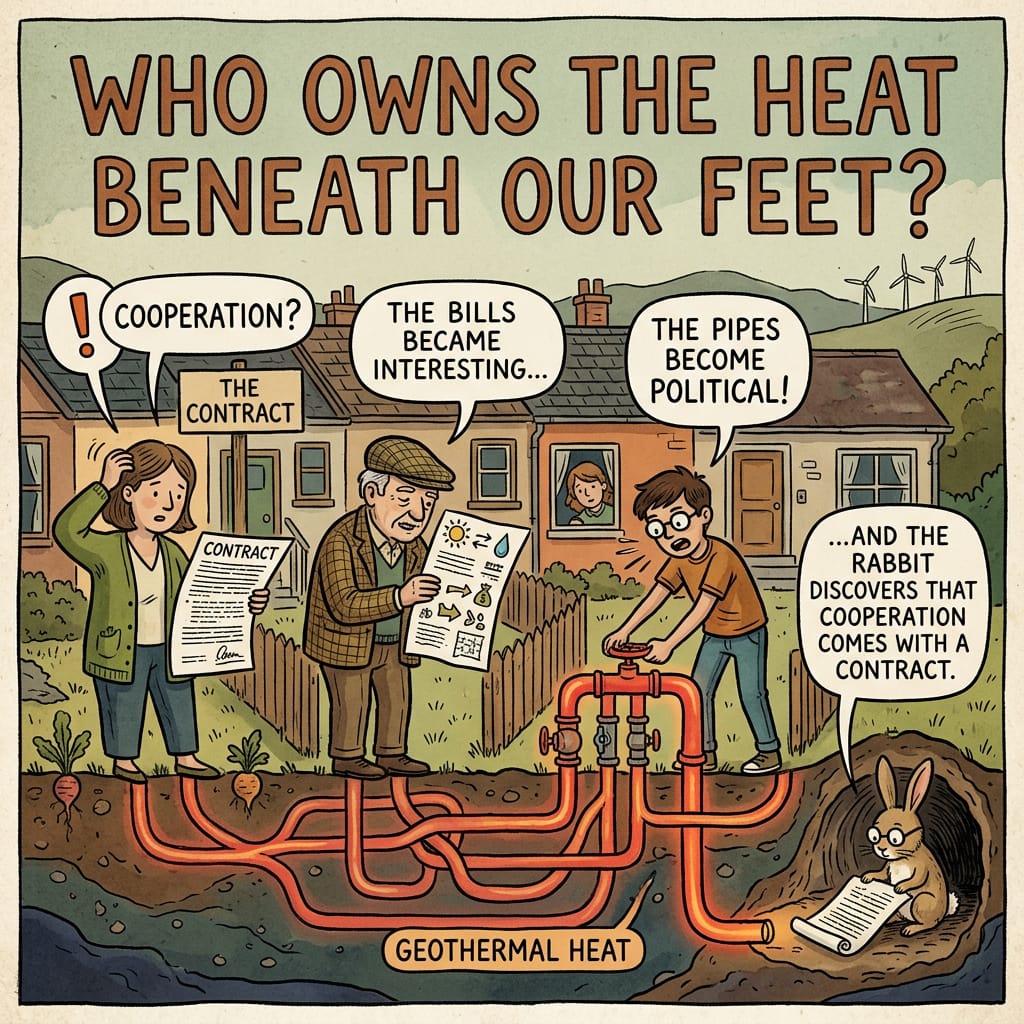
Who Owns the Heat Beneath Our Feet?
When neighbours share energy, the pipes become political, the bills become interesting, and the rabbit discovers that cooperation comes with a contract.
AITroT · Energy, Innovation & Economy · October 2026
The Rabbit Finds a Pipe.
Then Comes the Invoice.
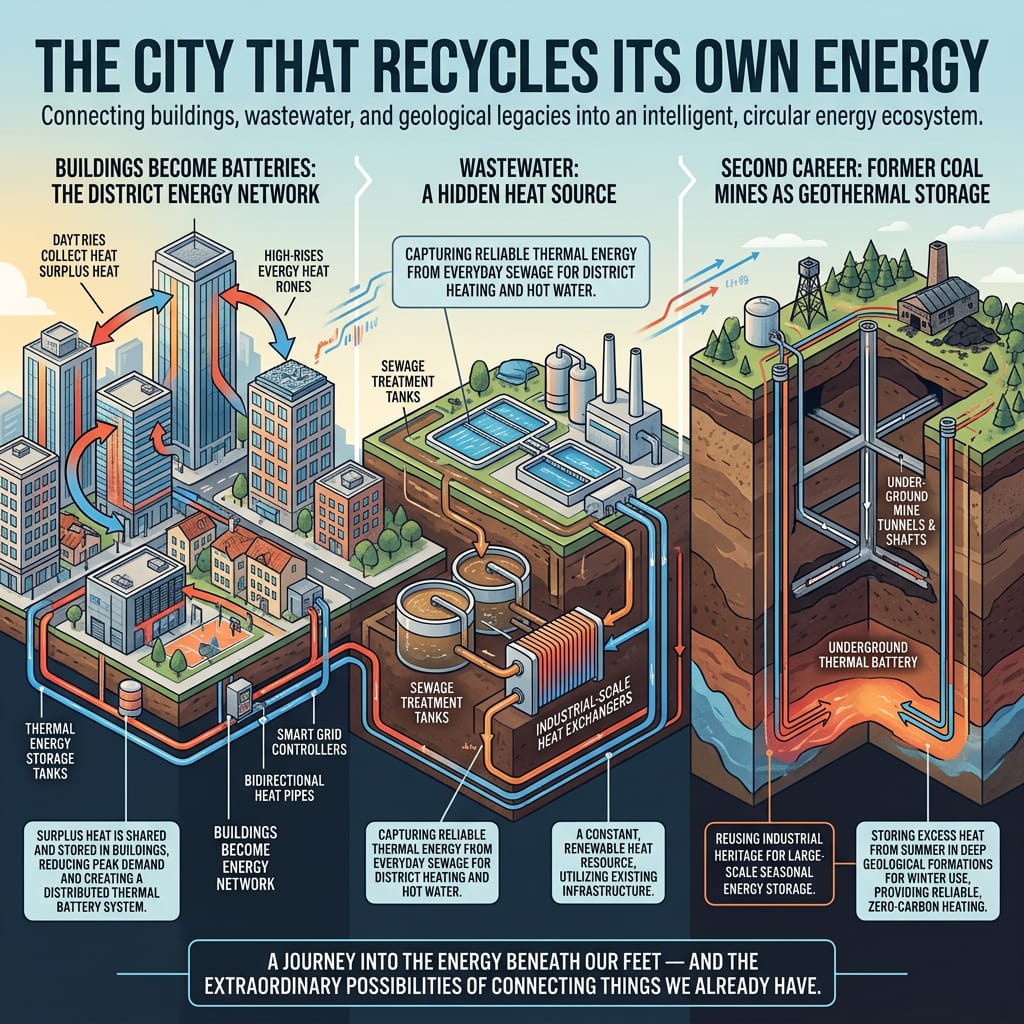
Remember our curious rabbit? Last time, it discovered a city where buildings exchanged heat. Supermarkets warmed apartments. Data centres supplied excess warmth to neighbouring offices. Abandoned coal mines enjoyed a second career as underground thermal reservoirs.
Everyone was delighted. The engineers admired their clever networks. The environmentalists celebrated reduced waste. The residents enjoyed warm homes.
And the rabbit, naturally, followed the pipes.
Until it arrived at a small office with an exceptionally large desk. Behind the desk sat a gentleman wearing a perfectly pressed suit.
“Welcome!” he announced. “I’m the network operator.”
The rabbit looked at the pipes running through the walls.
“Wonderful! Who owns the heat?”
“That depends.”
“Who owns the pipes?”
“Also depends.”
“Who pays for them?”
“Ah! Now we’re getting somewhere.”
The gentleman opened a folder.
A very thick folder.
The rabbit quietly put its carrots away. Apparently, the energy revolution had reached the accounting department.
When Free Heat Becomes Expensive Warmth
Let’s begin with a simple example. A supermarket produces excess heat through its refrigeration equipment. Nearby apartments need heating. An engineer connects the two buildings.
Energy recovered. Waste reduced. Everybody happy.
Except that someone must pay for the heat exchanger, pumps, underground pipes, meters, installation and maintenance. Someone must also pay for the electricity required to operate the system, including any heat pumps needed to raise the temperature.
Then there are insurance, financing, repairs, monitoring, administration and eventual replacement.
The excess heat may have little value to the supermarket when it cannot use it. But delivering it to another building has a cost. And that’s an important distinction: waste heat can be inexpensive. Useful delivered heat is not necessarily cheap.
Our supermarket owner might say:
“I’m providing energy that would otherwise be wasted. Surely I deserve something?”
The apartment residents might reply:
“We’re helping you dispose of unwanted heat. Shouldn’t you pay us?”
The network operator scratches his head. The engineer quietly leaves for lunch. And suddenly, a rather elegant technical solution has become a negotiation.
The Curious Case of the Heat Nobody Owned
Imagine a fictional neighbourhood called Warmington. It contains a supermarket, a school, an apartment building and a small swimming pool.
The supermarket produces excess heat. The swimming pool needs regular warmth. The school needs heating in winter, but much less during summer. The apartments require heating and domestic hot water.
A shared thermal network could improve the efficiency of the neighbourhood.
But who should own it?
Option One
The Private Operator
A company finances, builds and operates the network. Customers may pay connection fees, fixed charges and charges based on energy consumption. The advantage is straightforward: a specialised company manages the technical and financial responsibilities.
The disadvantage? Customers may have limited alternative suppliers once connected. You cannot easily remove an underground district heating connection and switch to another network the following afternoon.
A private operator can be efficient, innovative and reliable. It can also occupy a powerful commercial position.
Good contracts and sensible regulation matter.
Option Two
The Municipality
The local authority owns or controls the network, directly or through a public company. Its objectives may include affordable heat, emissions reduction and long-term community infrastructure. Surpluses, if generated, can potentially be reinvested in the network or public services.
But public ownership does not magically remove costs. Pipes still leak. Pumps still fail. Money still has to be borrowed. And political decisions do not always happen at the speed engineers would prefer.
The radiator may need replacing today.
The committee meets next month.
Option Three
The Energy Cooperative
Residents and other participants collectively own or govern the system. They may invest capital, elect representatives and participate in major decisions. Surpluses can be reinvested or distributed according to the cooperative’s rules.
This can align the interests of users and operators. But collective ownership also requires competent management, funding, technical expertise and clear accountability.
Democracy is valuable.
It does not automatically repair a broken circulation pump.
Option Four
Shared or Hybrid Ownership
The municipality provides land or infrastructure rights. A private company operates the network. Residents participate through a cooperative. A public institution offers financing or guarantees. Different organisations take responsibility for different elements.
This can distribute risks and combine expertise.
It can also produce a fascinating number of meetings.
And if responsibilities are poorly defined, everyone may own a small part of the success while nobody wants to own the failure.
Denmark
The Country Where Consumers Became Owners
One interesting example comes from Denmark. District heating plays an important role in the country’s energy system, and consumer ownership has a long tradition. Many networks operate through consumer-owned or municipally owned structures.
The underlying issue is important. A district heating network often resembles a local natural monopoly. Constructing several competing networks of underground pipes along the same street would usually make little economic sense.
But when customers depend on one network, they also depend on the organisation controlling it. Ownership and price regulation therefore become crucial.
Research examining Danish district heating has explored how consumer ownership can support trust and has documented cases where a change to consumer ownership was followed by lower prices. Forsyningstilsynet
Does that mean every cooperative is automatically cheaper than every private network? Of course not. Project costs, financing, governance and local conditions still matter.
But Denmark demonstrates something interesting: ownership isn’t merely a legal footnote. It can influence how the economic benefits of shared infrastructure are distributed.
And that brings us to a question that deserves much more attention: if everyone helps make an energy network successful, should everyone share in the value it creates?
Heerlen
Yesterday’s Coal, Tomorrow’s Shared Infrastructure
Let’s return to Heerlen, in the Netherlands. Its Mijnwater network uses former mining infrastructure as part of a modern heating and cooling system. Buildings can exchange useful thermal energy through the network, which also uses thermal storage and other sources.
But the system requires significant investment. In 2023, Enexis Holding announced further investment of nearly €80 million, while the Province of Limburg committed €40 million through the Limburg Energy Fund to support the network’s development. mijnwater.com
The funding illustrates something easily forgotten in discussions about renewable energy: a good idea is not enough. Even when the resource already exists underground, substantial capital may be required to make it useful.
Public bodies, infrastructure organisations, property owners and customers all have different roles. The project is as much about financing and coordination as it is about recovering heat.
Our rabbit would probably call this the moment when engineering meets the committee.
The Hidden Problem
Who Benefits First?
Imagine Warmington’s network is now operational. The supermarket supplies useful heat. The swimming pool consumes it. The apartments receive affordable heating. The operator earns revenue.
Everyone benefits.
Or do they?
Suppose the supermarket receives payment for its recovered heat, while apartment residents pay high fixed network charges. Suppose new customers receive attractive installation deals, but older customers financed the original infrastructure.
Suppose wealthy property owners can afford the upgrades needed for connection, while lower-income households cannot. Suppose the most profitable neighbourhood receives the network first, while neighbouring streets are left behind.
Suddenly, the energy transition raises questions about distribution. Who pays the initial costs? Who receives the long-term savings? Who carries the financial risks?
And who gets left outside the warm circle?
The engineering diagram may look beautiful. The economic arrangement can look rather different.
A truly successful energy project should not merely reduce waste. It should consider whether costs and benefits are allocated fairly.
When the Heat Supplier Changes Its Mind
Now imagine that Warmington’s supermarket closes. Perhaps the business relocates. Perhaps its refrigeration technology changes. Perhaps it reduces energy consumption. Perhaps it simply goes bankrupt.
What happens to the apartments depending on its surplus heat?
If the network relies heavily on one supplier, the loss can create substantial problems. Backup heating may be needed. Alternative energy sources may be expensive. Contracts may include penalties, guarantees or conditions allowing changes. And someone must decide who carries the financial consequences.
This is why long-term planning matters. Heat networks need more than an energy source. They need resilience: multiple sources where feasible, backup capacity and the ability to adapt when customers or suppliers change.
Otherwise, the apartment residents may discover that their heating system has unexpectedly followed the supermarket to another town.
Not an ideal moving arrangement.
Who Owns the Energy Data?
Here comes another less-walked path. Modern heating and cooling networks increasingly rely on sensors, smart meters and digital controls. The system may collect information about energy consumption, operating temperatures, equipment performance and demand patterns.
Some of this data is essential for billing and efficient operation. But sufficiently detailed consumption patterns can also reveal information about building occupancy and daily routines.
That raises questions about access, use and responsibility. Who can see the data? How long is it retained? Can it be shared with commercial partners? Can residents inspect or challenge inaccurate readings?
And what about automated decisions? What can the operator control, under what agreement, and who takes responsibility when those decisions go wrong?
An intelligent network needs information. It does not necessarily need unrestricted access to everyone’s private life.
The rabbit has a simple rule:
Measure the heat.
Don’t unnecessarily measure the household.
Energy Communities
A Neighbourhood With a Balance Sheet
What if the residents of Warmington created a local energy cooperative? The community could invest in thermal infrastructure, negotiate heat-purchase agreements and participate in governing the system.
Some members might contribute capital. Others might provide building space, access rights or useful thermal resources. The network could contract with a professional operator for maintenance.
Customers would pay for the services they use, while governance rules would determine how costs, risks and surpluses are shared. The result might be a locally accountable energy system.
But not every cooperative is automatically fair. Voting rights, investment requirements and membership rules all matter.
A cooperative where only affluent property owners can afford membership might reproduce the inequalities it was supposed to solve. And a system where the loudest voices make every decision may not be particularly democratic in practice.
Community ownership needs clear rules, transparency and safeguards for participants who cannot invest large amounts.
Belonging should not require a wealthy bank account.
The Strange Economics of Energy Nobody Wants
Here’s another interesting paradox. In some situations, recovered heat is worth almost nothing at the location where it is produced.
A factory may have no use for its low-temperature waste heat. A data centre may spend money removing heat. A supermarket must continuously reject warmth from refrigeration systems.
But once that energy is connected to a useful customer, its value changes. The heat has not suddenly become more energetic.
Its accessibility and usefulness have changed.
Value is not determined only by how much energy exists. It also depends on temperature, timing, accessibility, reliability and demand.
Warm water at an isolated industrial site may have little commercial value. A connection to a neighbourhood with steady heating demand may turn it into an asset.
Of course, the network must recover enough value to cover its expenses. Which brings us to something the rabbit finds deeply suspicious.
A spreadsheet.
The Network That Looks Profitable … Until It Isn’t
Imagine a project developer estimates that Warmington’s thermal network will serve 500 homes. The construction budget assumes all 500 will connect.
But only 200 households agree.
The network still needs its main pipes, pumping equipment and much of its control infrastructure. Those fixed costs must now be recovered from far fewer customers. The business case changes dramatically.
Connection rates are therefore essential. So are expected energy demand, financing costs, maintenance expenses and network lifespan. A project can be technically brilliant and financially fragile.
This is not unique to thermal networks. Similar problems appear in transport systems, telecommunications, water infrastructure and electricity grids. Shared infrastructure often becomes more economical when enough people use it.
But getting those people to participate requires trust. And trust requires more than a glossy brochure.
It requires understandable prices, reliable service and fair treatment.
Great Britain Introduces New Heat Network Protections
A recent regulatory development makes this discussion particularly relevant. On 27 January 2026, Ofgem launched new consumer protection rules for heat networks in Great Britain: England, Scotland and Wales. The initial protections cover billing, customer service, complaints handling and support for vulnerable consumers, with regulation being introduced in phases. Ofgem
Why does that matter? Because households connected to heat networks may not have the same freedom to change suppliers as customers buying gas or electricity in competitive retail markets.
When customers cannot easily leave, the rules governing the relationship become especially important.
These protections do not eliminate every problem. But they recognise a fundamental issue: a heating network is more than an engineering installation.
It is an essential service.
And essential services require accountability.
Seven Questions Before Connecting the Neighbourhood
Before signing a contract for a shared thermal network, the rabbit would like some answers.
- Who owns the infrastructure?
A private company, municipality, cooperative or combination? - Who decides the prices?
Are tariffs understandable, regulated where applicable, and open to scrutiny? - Who pays for construction and future repairs?
What happens when the original equipment reaches the end of its useful life? - What happens if a major heat supplier disappears?
Are there alternative sources and emergency arrangements? - Who benefits financially?
Do customers receive savings, reliable service or a share in long-term value? - Who controls the information?
Are energy data and automated decisions handled transparently and responsibly? - Can customers leave, and under what conditions?
If switching is technically difficult, what other protections exist?
Seven questions. Not particularly glamorous.
But considerably easier to answer before the street is dug up.
Perhaps the Next Energy Revolution Is Social
We began this series by exploring sources of energy: waves, hydrogen, geothermal heat, ocean temperatures and the differences between freshwater and saltwater. Then we discovered that energy is already escaping from buildings, factories, computers and underground systems.
And now we arrive at something even more curious. The technology to share useful heat may exist. The resource may exist. The customers may exist. But unless everyone can agree on ownership, investment, pricing and responsibility, the network may never be built.
The obstacle isn’t always physics. Sometimes it’s the contract. Sometimes it’s the financing. Sometimes it’s an argument about who digs up the road.
And sometimes it’s a perfectly reasonable resident asking:
“What happens to my heating bill?”
Perhaps the most important breakthrough is not another machine. Perhaps it is designing systems where the incentives, responsibilities and benefits make cooperation worthwhile.
Because infrastructure connects buildings.
But trust connects people.
And without trust, even the cleverest network can fail.
The Rabbit Meets the Treasurer
Our rabbit finally emerges from Warmington’s network office. It has learned about pumps, meters, tariffs, financing, ownership models and consumer protection.
Its notebook is nearly full.
The network operator smiles.
“So, what do you think of our wonderful new heating system?”
The rabbit considers the question.
“The engineering is impressive.”
“Thank you!”
“The waste reduction is promising.”
“Excellent!”
“And sharing useful energy between buildings makes a lot of sense.”
The operator beams. Then the rabbit asks one final question.
“Does everyone understand what they’re paying for?”
The smile becomes slightly smaller.
“Well…”
“And who makes the decisions?”
“Ah…”
“And who takes responsibility if things go wrong?”
The operator reaches for the thick folder again. The rabbit shakes its head.
“No need. I think I know where our next meeting should be.”
“Where?”
“The community hall.”
The operator looks surprised.
“But the engineers are meeting tomorrow!”
“Good,” says the rabbit.
“Invite them too.”
Then it closes its notebook and writes a sentence on the cover:
The future of energy isn’t just about what we can share. It’s about how fairly we share the costs, the benefits and the responsibility.
The rabbit walks away. Behind it, the water continues flowing beneath the streets. Above it, the residents are beginning to talk.
And this time, the most important connection may not be underground at all.
Text with help of OpenAI’s GPT language models , Images with help of DALLE, openai chatbox, DALLE , Fleeky & MI
AITroT — Exploring tomorrow’s technologies, today’s economics, and the humans who must somehow make them work together.
Research behind the story
The fictional town of Warmington illustrates genuine questions faced by real heat networks.
- Denmark — consumer ownership of district heating: Research into ownership, monopoly pricing and consumer
- Mijnwater — investment and expansion: Details of the Dutch network’s public-sector-backed expansion.
- Ofgem — heat network consumer protection: Great Britain’s 2026 rules covering billing, service and customer protections.
We’ve now followed the rabbit through three connected questions:
Where can energy come from?
Why do we waste so much of it?
And who owns the infrastructure that allows us to share it?
The third question adds a new dimension to AITroT: technology does not become progress merely because it works. It becomes progress when people can benefit from it, trust it, and hold someone accountable when it fails.
And that gives us a rather interesting trilogy.
Free Energy Explorer GPT
Explores actual free energy inventions and discoveries.

Thank you for questions, shares and comments!
Share your thoughts or questions in the comments below!