The Energy We Can Harvest & Cannot Yet Afford to Keep
When the ocean sends us an invoice, hydrogen changes its colours, and the future of energy hides in unexpected places.
The Ocean Has Plenty of Energy. Unfortunately, It Also Has a Temper.
Imagine standing on a beach, watching the waves roll in. One after another. Day and night. Free energy, delivered straight to your doorstep.
No fuel trucks. No mining. No smoke.
Wonderful!
An engineer arrives, carrying a notebook.
“We could turn those waves into electricity!”
An investor arrives, carrying a calculator.
“How much?”
The engineer explains the technology, the machinery, the installation and the expected output. The investor nods.
Then a storm arrives.
And the ocean eats the machinery.
Welcome to renewable energy, where generating electricity is sometimes the easy part. Keeping the equipment alive, reliable and affordable is where the real adventure begins.
Wave Energy
The Machine That Cannot Take a Holiday
Wave energy has some remarkable advantages. Waves carry substantial energy, their movements can be forecast, and powerful wave resources are available along many coastlines. Forecastable, however, does not mean constant.
Various technologies attempt to capture that movement. Some float, some are anchored to the seabed, and others use oscillating water columns to drive turbines.
In theory, rather elegant.
In practice, imagine installing a washing machine in the North Atlantic, leaving it on the spin cycle for twenty years, and occasionally asking a hurricane to inspect it.
Saltwater corrodes materials. Waves repeatedly stress components. Mooring systems must survive enormous forces. Marine organisms settle on surfaces, and repairs may require specialised ships and favourable weather. A machine designed to capture powerful waves must also survive waves so powerful that capturing them becomes dangerous.
A wind turbine can turn its blades to reduce loads in extreme winds. Wave devices also have survival strategies, but these depend on the design and introduce their own engineering demands.
A wave machine cannot politely ask the ocean to stop waving.
A 2026 scientific review identified structural failures and mooring problems as recurring obstacles in wave energy’s development. Infrastructure matters, but so does having equipment that survives long enough to use it. Oxford Academic
That changes the question. It is not simply: Can we generate electricity from waves?
It is: Can we generate enough electricity, for enough years, to pay for the machinery, installation, maintenance and eventual replacement?
And still have something left over?
A rather demanding customer, that ocean.
Hydrogen
Fifty Shades of Green
Hydrogen often appears in discussions about renewable energy. There is green hydrogen, blue hydrogen, grey hydrogen, and several additional colours. Enough to confuse a painter.
But hydrogen is not automatically renewable. It is an energy carrier, meaning we must first produce it using another energy source.
Most hydrogen today is still manufactured using fossil fuels, especially natural gas and coal. According to the International Energy Agency’s Global Hydrogen Review 2026, low-emissions hydrogen production remained below 1% of global output in 2025. That is quite a gap between hydrogen’s publicity and its present reality. Global Hydrogen Review 2026
Green hydrogen can be produced by splitting water using renewable electricity.
Wonderful again.
Except that every conversion requires energy.
Electricity produces hydrogen. The hydrogen must often be compressed, cooled, transported or stored. When converted back into electricity, more energy is lost.
Imagine buying a full bottle of lemonade, pouring it into another bottle, transporting it across town, and discovering that only part of the original drink remains. You might reasonably ask why you didn’t simply bring the first bottle.
For many applications, directly using electricity is more efficient. But that doesn’t make hydrogen useless. Quite the contrary.
Hydrogen and hydrogen-derived fuels may be valuable for chemical production, fertilisers, steelmaking and potentially parts of shipping or aviation where direct electrification is difficult.
The trick is knowing where hydrogen solves a real problem. Not every energy problem needs a hydrogen-shaped answer.
And painting the bottle green doesn’t change what went into it.
The Hidden Bill
Energy Needs More Than a Clever Generator
Every energy technology faces its own version of the same challenge.
Solar panels require materials, land or roof space, grid connections and sometimes storage. Wind turbines require maintenance, foundations, transmission lines and access to suitable locations. Hydropower depends on geography, water availability and environmental considerations.
Nuclear energy requires sophisticated engineering, financing, safety systems, waste management and long-term planning. Geothermal energy demands suitable underground conditions or technologies capable of reaching deeper, hotter rock.
None of these challenges automatically makes a technology bad. It means we must look beyond the pretty photograph.
A technology’s true value depends on its complete system: construction, operating life, usable energy delivered, reliability, maintenance, environmental impacts and eventual decommissioning.
And something else: when does the energy arrive, and does anyone need it at that moment?
A cheap surplus of electricity at noon is not necessarily a cheap supply of electricity at midnight.
A brilliant generator with no grid connection is rather like a magnificent restaurant without a road. The food may be excellent.
But how do the customers get there?
The Less-Walked Paths
Energy Hiding in Unexpected Places
Fortunately, the energy world contains far more than the usual solar, wind and hydrogen headlines. Some of the most interesting ideas are almost embarrassingly simple. Others sound like they escaped from a science-fiction novel.
And a few might turn yesterday’s waste into tomorrow’s valuable resource.
1. Blue Energy.
When Freshwater Meets Saltwater
Did you know electricity can be generated from the difference in salt concentration between two bodies of water?
Freshwater and saltwater naturally tend to mix. Their difference in chemical potential offers energy that special membranes can help capture, using processes such as pressure-retarded osmosis or reverse electrodialysis.
No sunshine required.
Just water with different concentrations of salt—and some rather clever equipment.
In August 2025, an osmotic power installation began operating in Fukuoka, Japan. It combines concentrated seawater from a desalination plant with treated wastewater, with expected annual electricity production of approximately 880,000 kilowatt-hours. japan.go.jp
This is not enough to replace a major power station. But that misses the interesting part: the plant uses streams that already exist within water infrastructure. Instead of building an entirely new energy landscape, engineers are recovering value from processes already taking place.
The challenges include expensive membranes, fouling, pumping requirements, maintenance and the need for suitable locations.
Even saltwater has a maintenance department.
2. Superhot Rock.
Earth’s Underground Furnace
We already know how to use geothermal heat. But what if we could reach rocks far hotter than those used by many conventional geothermal installations?
Researchers are exploring superhot geothermal systems, including rock temperatures above 400°C. At sufficiently high temperatures and pressures, water can become supercritical, acquiring properties that make it attractive for extracting and transporting heat.
The possibility is extraordinary: powerful geothermal resources capable of delivering electricity around the clock.
But the engineering is formidable.
Drilling into extremely hot rock places enormous demands on equipment, materials, measurement systems and well integrity. Controlling fluid circulation underground adds further complications. And drilling a beautiful hole is not the same as operating a profitable power station.
The Earth’s furnace is impressive.
Unfortunately, it does not come with a convenient service hatch.
3. Abandoned Mines.
Yesterday’s Holes, Tomorrow’s Heating?
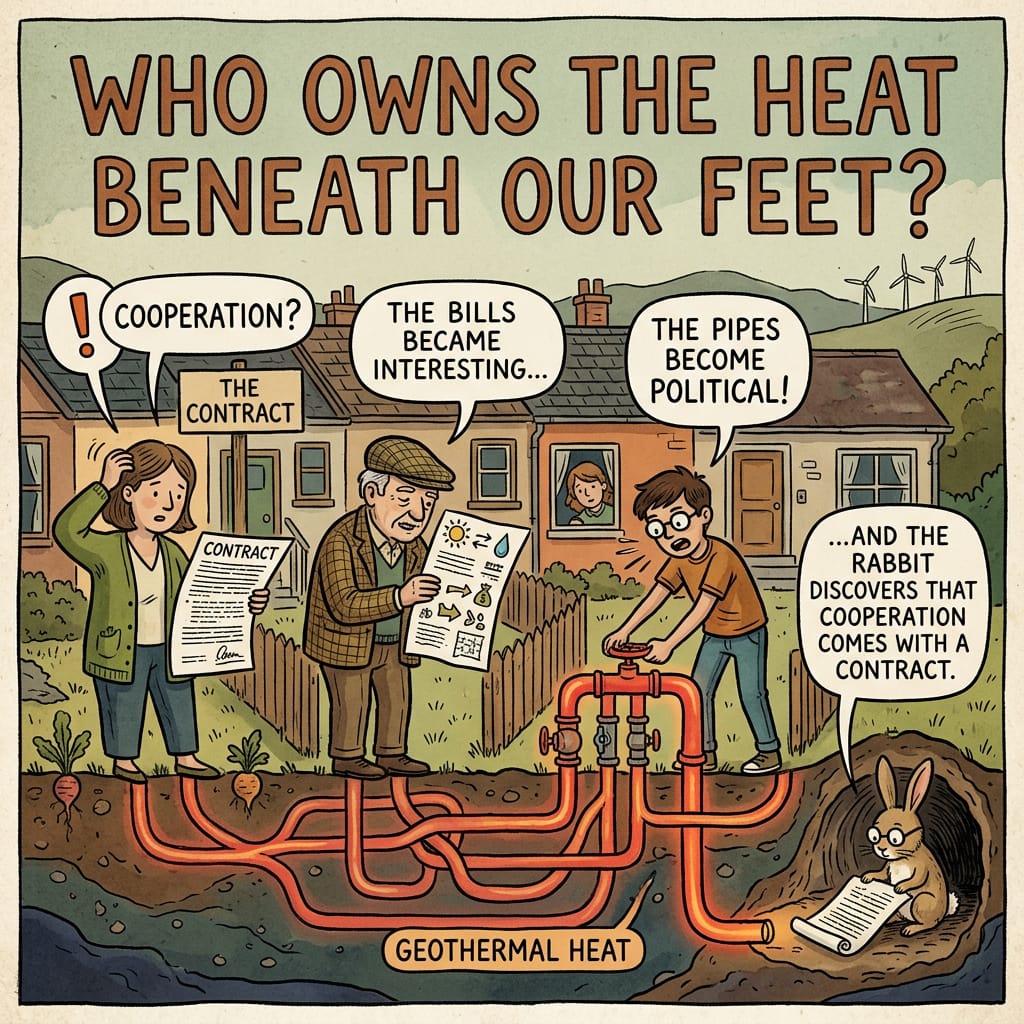
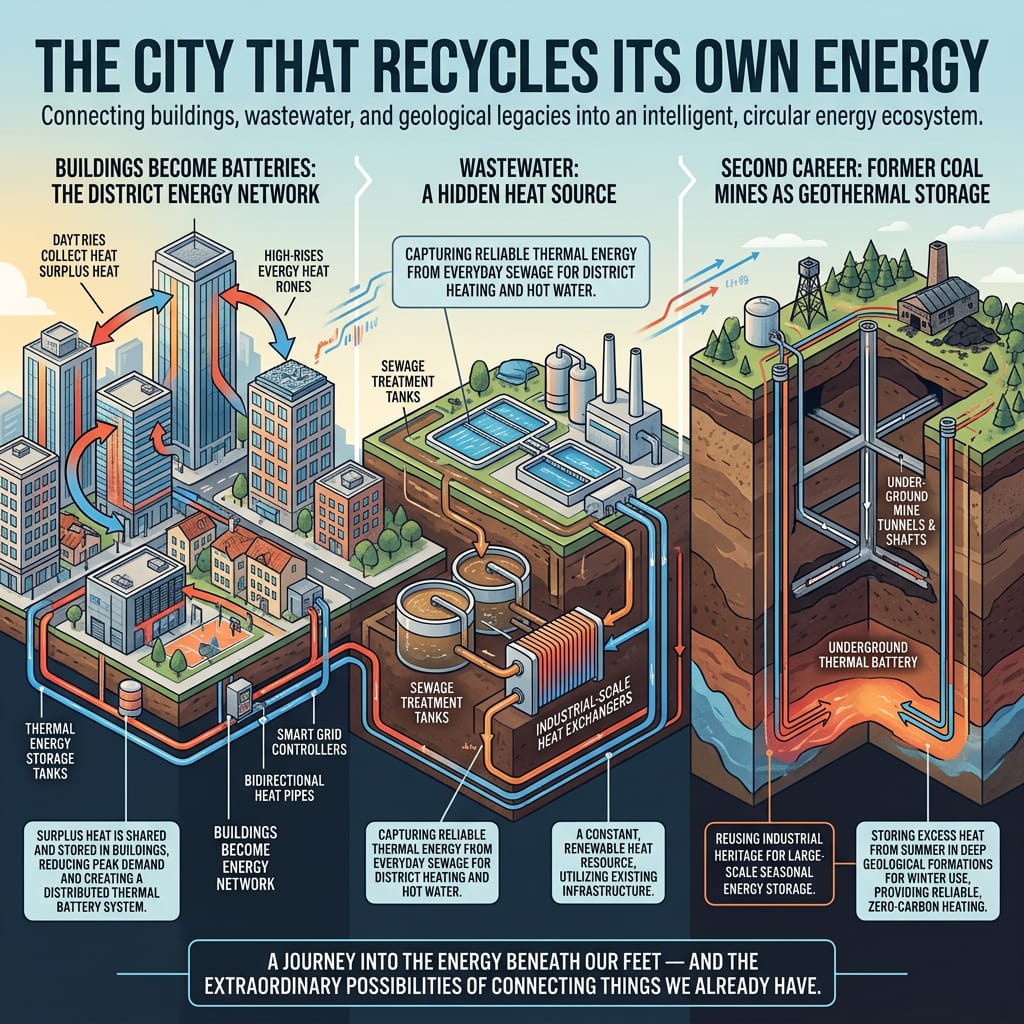
Old mines are often regarded as industrial leftovers. Yet flooded underground workings can contain water at useful temperatures. With heat pumps and properly designed systems, that water can provide heating or cooling for nearby buildings.
Instead of seeing an abandoned mine only as a liability, some communities see a potential local energy asset.
This is generally about heat rather than electricity. An important distinction: not every useful energy resource needs to turn a turbine. Sometimes the smartest thing we can do is stop burning expensive fuel merely to warm water.
The challenges include water chemistry, pumping, temperature management, the distance to customers and long-term monitoring.
Still, there is something wonderfully ironic about old coal infrastructure helping reduce future fossil-fuel use.
Yesterday’s mining problem becomes tomorrow’s heating opportunity.
4. Waste Heat.
The Energy Escaping Through the Back Door
Factories, industrial furnaces, data centres and numerous other installations release heat. Some of it is unavoidable. Some of it can be recovered.
Waste heat can sometimes be used directly for heating, upgraded through heat pumps, or converted into electricity where temperatures and economics permit.
Consider a data centre. The computers consume electricity and produce heat. Traditionally, that heat may simply be removed and released into the surroundings. But where a suitable district heating network exists, some of it can be reused to warm nearby buildings.
The catch? Heat is not always available at the temperature customers need, at the time they need it, or close enough to be worth transporting. Turning low-temperature heat back into electricity is especially difficult.
Physics keeps sending invoices.
Still, using otherwise wasted heat can be far more practical than building an exotic new generator.
5. Ocean Thermal Energy.
A Power Station With a Temperature Difference
Warm surface seawater and cold deep seawater offer another energy opportunity. Ocean Thermal Energy Conversion, or OTEC, uses that temperature difference to operate a heat engine.
It is particularly interesting in tropical regions where warm surface water and colder deep water may be available throughout the year. The potential advantage is relatively steady operation.
The disadvantages? The temperature difference is modest, so conversion efficiency is low. Large quantities of seawater must be pumped, and marine infrastructure is expensive. Pipes must withstand offshore conditions, while pumping requirements and other system losses can consume a significant fraction of the generated energy.
The ocean offers the heat.
The engineer must provide almost everything else.

Five Questions Every New Energy Miracle Should Answer
Before celebrating the next revolutionary energy invention, I would ask five simple questions.
- Where does the energy actually come from?
Not the marketing label. The real physical source. - How much usable energy remains?
After production, conversion, pumping, storage, transport and other losses. - How long can the installation survive?
Not just in a laboratory, but under actual operating conditions. - What does the complete system cost?
Include construction, maintenance, downtime, infrastructure, replacements and eventual removal. - Who can use the energy, where and when?
Producing electricity without an economically practical way to deliver or use it is not much of a business model.
And I would add a sixth question, purely for entertainment:
What happens when the first unexpected problem arrives?
Because something always does.
Usually just after the warranty expires.
Energy Density Is Not the Same as Economic Value
Here is one of the most fascinating traps in energy discussions: an enormous amount of energy may exist in a natural resource, but that does not mean we can collect it cheaply.
The ocean contains extraordinary energy. The Earth’s interior contains vast amounts of heat. Sunlight delivers more energy to our planet than civilisation consumes. But having energy available and having useful energy delivered to a customer are two very different things.
A fisherman knows the sea contains plenty of fish.
That doesn’t mean every fishing trip makes a profit.
The same applies to energy. Technical potential is not the same as economic potential. A laboratory demonstration is not a commercial installation. And a commercial installation is not automatically a scalable industry.
Perhaps the Future Is Not One Giant Solution
We often discuss energy as though a single technology must win. Solar versus nuclear. Wind versus fossil fuels. Hydrogen versus batteries.
A competition with one trophy and a very expensive podium.
But the future may be more interesting than that.
Sunny regions may benefit enormously from solar energy. Windy coastlines may favour offshore wind. Certain industries may require hydrogen-derived fuels. Some communities could use mine-water heating, while others might exploit geothermal resources.
Blue energy may find its niche beside water treatment plants. Waste heat may become an important part of local heating networks. And wave energy may eventually find designs and locations where the electricity justifies its formidable engineering costs.
There may never be one perfect energy source. Instead, we may need better combinations, smarter infrastructure, more efficient use of resources and technologies designed for their actual environments.
Less competition over which technology is fashionable.
More attention to which one works.
The Real Energy Revolution May Be About What We Stop Wasting
A reader recently questioned two entries in an energy comparison table I published in 2024. Was the main difficulty with wave energy really the lack of infrastructure, or was surviving the ocean the bigger challenge? And why describe hydrogen as renewable when most hydrogen production still depends on fossil fuels?
Both questions exposed something important.
Labels simplify. Reality complicates.
“Renewable” doesn’t automatically mean low-impact, affordable or efficient. “High energy density” doesn’t guarantee commercially useful electricity. “Green hydrogen” describes a production pathway, not every hydrogen molecule on the market. And a beautiful prototype doesn’t guarantee a machine that survives twenty winters at sea.
The challenge is not merely discovering more sources of energy. It is learning to harvest them without wasting too much energy, money, material or environmental value along the way.
Perhaps the next breakthrough won’t be a spectacular new invention. Perhaps it will be a better membrane, a more reliable bearing, a stronger cable, a cheaper drilling technique, or a heat exchanger that lasts twice as long.
Not particularly glamorous. Hardly the stuff of dramatic headlines. But it might make the difference between an exciting experiment and a dependable energy system.
And somewhere in the North Atlantic, a wave crashes against a machine.
The machine survives.
The engineer smiles.
The investor cautiously opens the calculator.
Now that would be progress.
AITroT — Exploring the technology behind tomorrow, without forgetting the engineering bills that arrive today.
Research notes and sources
I’ve kept the article readable and story-driven, but its main technical claims are supported by current research:
- Wave survivability: A July 2026 review documents the importance of structural and mooring failures.
Oxford Academic
- Hydrogen: The IEA’s 2026 review confirms that low-emissions hydrogen remained below 1% of global production in 2025.
IEA
- Blue energy: Japan’s Fukuoka installation began operating in August 2025, with expected output of 880,000 kWh annually.
Fukuoka Now
- Superhot geothermal: The IEA Geothermal collaboration is investigating technologies for rock temperatures above 400°C.
International Energy Agency Geothermal
- Mine-water heating: Heerlen, in the Netherlands, is a documented example of repurposing old coal-mine infrastructure for heating and cooling.
Publications Office of the EU
- Waste heat and ocean thermal energy: Both have promising applications, but heat delivery, conversion efficiency and infrastructure remain important constraints.