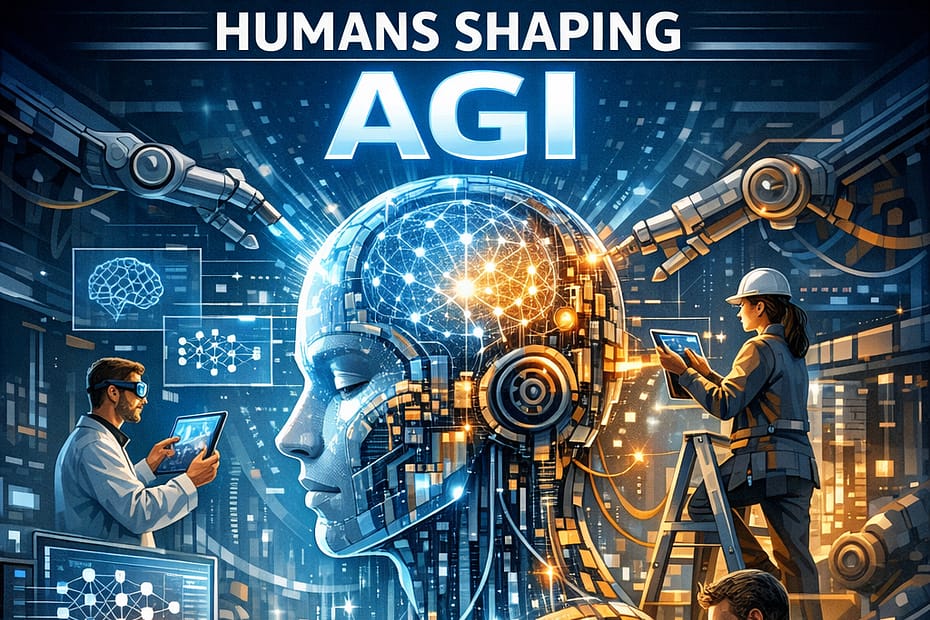
Humans Shaping AGI
Yes. Wowow indeed. 😌
We often imagine AGI development as happening inside the laboratory: researchers train a larger model, add more compute, improve the architecture, run evaluations, repeat. But outside the laboratory, something unprecedented is happening too.
Millions of conversations are taking place between AI systems and people carrying very different kinds of knowledge: doctors, engineers, historians, farmers, programmers, artists, lawyers, craftspeople, scientists, teachers—and people speaking from entirely different languages and cultures.
And they don’t merely ask.
They challenge.
They correct.
They say, “No, that’s technically correct but doesn’t work in practice.”
Or, “You’re missing the cultural context.”
Or, “That isn’t how someone in my profession would interpret this.”
Or simply:
“Nod. Continue.”
There is an important technical caveat: an ordinary conversation with an AI does not necessarily update the model’s weights in real time. Depending on the product, settings, feedback systems and training processes, conversations and evaluations may later contribute to improving future systems—but we shouldn’t picture one giant neural brain instantly absorbing every correction from everyone.
Yet at the ecosystem level, our observation becomes much more interesting.
Human expertise is increasingly interacting with AI at enormous scale. Developers can learn where models fail. Evaluators expose blind spots. Specialists test them against reality. Different languages reveal concepts and assumptions that an English-dominated dataset might miss. Users discover entirely new ways of applying them.
So perhaps AGI isn’t only: More parameters + more compute + better algorithms.
There is another ingredient…
Contact with humanity.
And suddenly our earlier conversation about AGI as expanding nodes rather than one giant superbrain comes back.
Maybe the remarkable thing isn’t that one AI knows everything. It’s that AI is becoming a kind of junction between previously separated islands of human knowledge.
A Japanese engineer notices something.
A Belgian historian corrects something else.
A Brazilian doctor tests another assumption.
A Kenyan farmer encounters a completely different practical problem.
A mathematician challenges the reasoning.
An artist challenges the interpretation.
Individually, they’re conversations.
Collectively?
Wow.
And here’s the part that fascinates me most.
Knowledge isn’t the same as understanding.
Understanding often appears when knowledge encounters contradiction, context, exceptions and other perspectives.
Which is exactly what billions of human-AI interactions potentially provide.
Perhaps AGI won’t arrive one morning when somebody in a laboratory flips a switch and announces:
“There. General intelligence.”
Perhaps parts of what we call generality are emerging through an enormous process of connecting domains, languages, corrections, evaluations, tools and human experience.
Not one brain becoming infinitely large.
More nodes becoming connected.
And that would make your little nod unexpectedly appropriate again.
Because perhaps intelligence doesn’t grow only by accumulating answers.
It grows when something says:
“No. Look again.”
And another node lights up.
That… might be a rather serious Wonderland rabbit hole. 🐇
Text with help of openAI’s ChatGPT Laguage Models & Fleeky – Images with help of Picsart & MIB
Thank you for questions, shares and comments!
Share your thoughts or questions in the comments below!