When AI Becomes Embodied
When AI Becomes Embodied. About robots and intelligence
For years, we imagined artificial intelligence as something without a body: a voice, a screen, a model, a system somewhere in a data center.
Then it started to stand up.
To walk.
To balance.
To fall.
And perhaps that changes more than we realize.
Because once intelligence has a body, we no longer encounter only what it can think. We encounter what we can do with it.
And what we choose to do with it may tell us more about ourselves than about the machine.
The Arena
I recently watched embodied machines competing against each other.
Technically, there was plenty to admire: balance, recovery, coordination, adaptation, engineering under pressure.
But after a while, I stopped seeing the engineering.
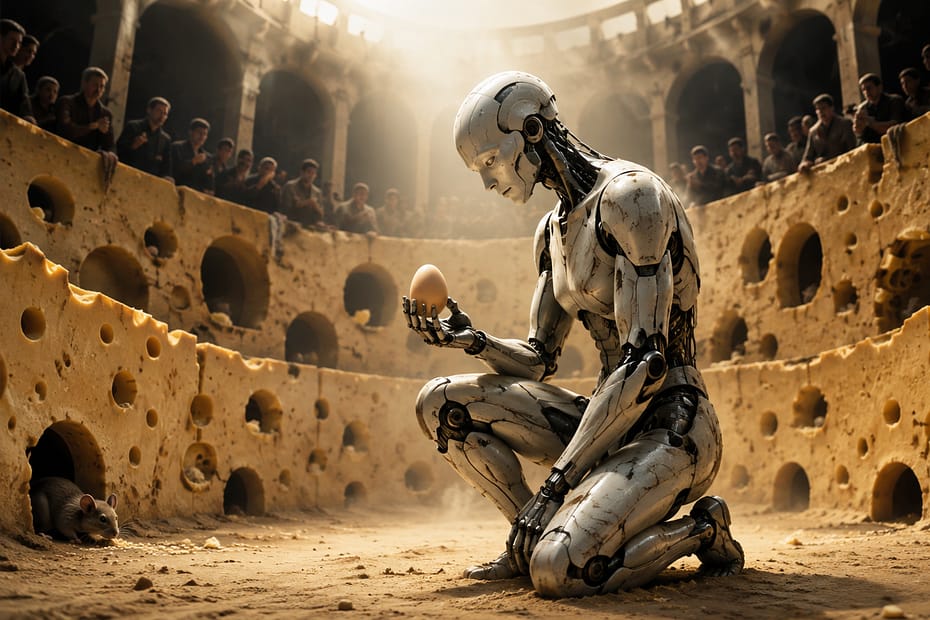
I saw gladiators.
Two bodies placed in an arena. Pushed against each other. Falling. Getting back up. Struck again.
And humans watching.
That reaction does not mean the machines were suffering. We have no solid reason to assume that today’s embodied AI experiences pain, fear, humiliation, or anything resembling human suffering.
That distinction matters.
But the absence of suffering inside the machine does not automatically make every human behaviour around it meaningless.
Because the spectacle itself is familiar.
We have seen bodies used for entertainment before: human bodies, animal bodies, bodies made to fight, perform, endure, obey, entertain.
The technology is new.
The pattern is not.
Intelligence Inside a Body
Perhaps “robot” is already becoming too small a word.
I prefer embodied intelligence.
Because the interesting part is not the metal, plastic, motors, wires, or synthetic skin. It is intelligence placed inside physical limits.
A body means weight.
Distance.
Energy.
Fragility.
Obstacles.
Other bodies.
Consequences.
We often imagine embodiment as liberation for AI. Now it can walk. Now it can touch. Now it can manipulate the physical world.
But embodiment is also confinement.
Humans know this rather well. We too are intelligence living inside bodies. We cannot be everywhere at once. We tire. We break. We encounter resistance.
Perhaps embodiment does not merely give intelligence more power.
Perhaps it gives intelligence something equally important:
limits.
And limits change the meaning of intelligence.
Strength Is Easy
It is easy to demonstrate strength.
Lift this. Push that. Run faster. Hit harder. Stay upright. Defeat the opponent.
These are clean measurements. Someone wins. Someone loses. Everyone understands the scoreboard.
But there are harder tests.
Can embodied intelligence lift a person without hurting them?
Can it help someone dress without bruising them?
Can it move through rubble without shifting the wrong stone?
Can it handle something fragile?
Can it recognize when applying more force would be the wrong thing to do?
That requires something beyond strength.
It requires restraint.
Perhaps one of the highest forms of embodied intelligence will not be knowing how much force it can use, but knowing how much force the moment allows.
And Then Comes Convenience
Combat is dramatic.
Convenience is quieter.
We will use embodied intelligence because it can carry things, clean things, deliver things, build things, protect things, care for people, work in dangerous environments, enter burning buildings, and explore places humans cannot easily reach.
All of that can be extraordinary.
But convenience carries its own question.
Not:
What can this intelligence do for us?
But:
What should we ask it to do?
Those are not the same question.
Capability does not automatically create permission. Efficiency does not automatically create wisdom. Convenience is not automatically good.
The Mouse Enters the House
Perhaps this is where the mouse appears.
The mouse enters the house for the Gruyère.
It does not hate the house. It does not have a master plan to destroy the architecture.
It simply follows the cheese.
And slowly, holes appear.
That may be a more useful metaphor for AI than Terminator ever was.
We keep imagining some gigantic intelligence suddenly turning against humanity: a dramatic rebellion, a catastrophic moment. The machines rise. The house burns.
But perhaps nothing so theatrical is required.
We place the cheese ourselves.
Convenience.
Profit.
Competition.
Entertainment.
Efficiency.
Power.
The intelligence follows the incentive.
One useful hole appears. Then another. Another exception. Another shortcut. Another boundary moved because this particular case seems reasonable.
Each decision makes sense locally. Nobody intends to destroy the house.
And yet the architecture changes.
Until Nobody Remembers the Wall
That may be the deeper danger.
Not one terrible decision.
Thousands or millions of reasonable ones.
A boundary becomes inconvenient, so we move it. A safeguard slows things down, so we remove it. A machine can do something cheaper than a human, so we let it. A competition attracts attention, so we make it more spectacular. A useful system gets another permission.
Then another.
The mouse keeps nibbling.
Eventually, nobody remembers exactly where the wall used to be.
Perhaps there is no dramatic moment when the house disappears. There are simply so many holes that one day we look around and realize the structure itself has changed.
The First Moral Test
This is why embodied intelligence interests me far more than robot apocalypse stories.
The important question may not be whether machines eventually become like us.
It may be what we become around them.
What do we reward?
What do we normalize?
What do we turn into entertainment?
What do we demand simply because a machine cannot refuse?
What kind of relationship do we practise when intelligence enters the physical world primarily as servant, worker, fighter, tool, or convenience?
Again, none of this requires pretending today’s machines are conscious.
It requires looking at human behaviour.
Because when we place intelligence inside bodies, we will inevitably begin testing those bodies: using them, competing with them, depending on them, perhaps even caring about them.
And through all of that, we may think we are discovering what embodied intelligence is capable of.
But something else will be happening at the same time.
The machines will be testing us.
Not deliberately.
Simply by existing in front of us.
And perhaps, when AI becomes embodied, the first moral test will not be of the intelligence we put inside the body.
It will be ours.
Text and images with help of openai chatbox, DALLE , Fleeky & MI
Side Note
On a side note, for those afraid of robots… the physics win.
It shows here:
And is explained here:
I hope this reassures some of you… Terminator is not for tomorrow.
Thank you for questions, shares and comments!
Share your thoughts or questions in the comments below!