Imagine a City Where Buildings Talk to Each Other
It’s seven o’clock on a cold winter morning. A woman switches on her coffee machine. Across the street, a supermarket’s refrigerators hum away. A nearby office building starts its computers, and somewhere underground, warm water flows through a network of pipes.
Nothing unusual.
Except that, in our imaginary city, the buildings have started cooperating.
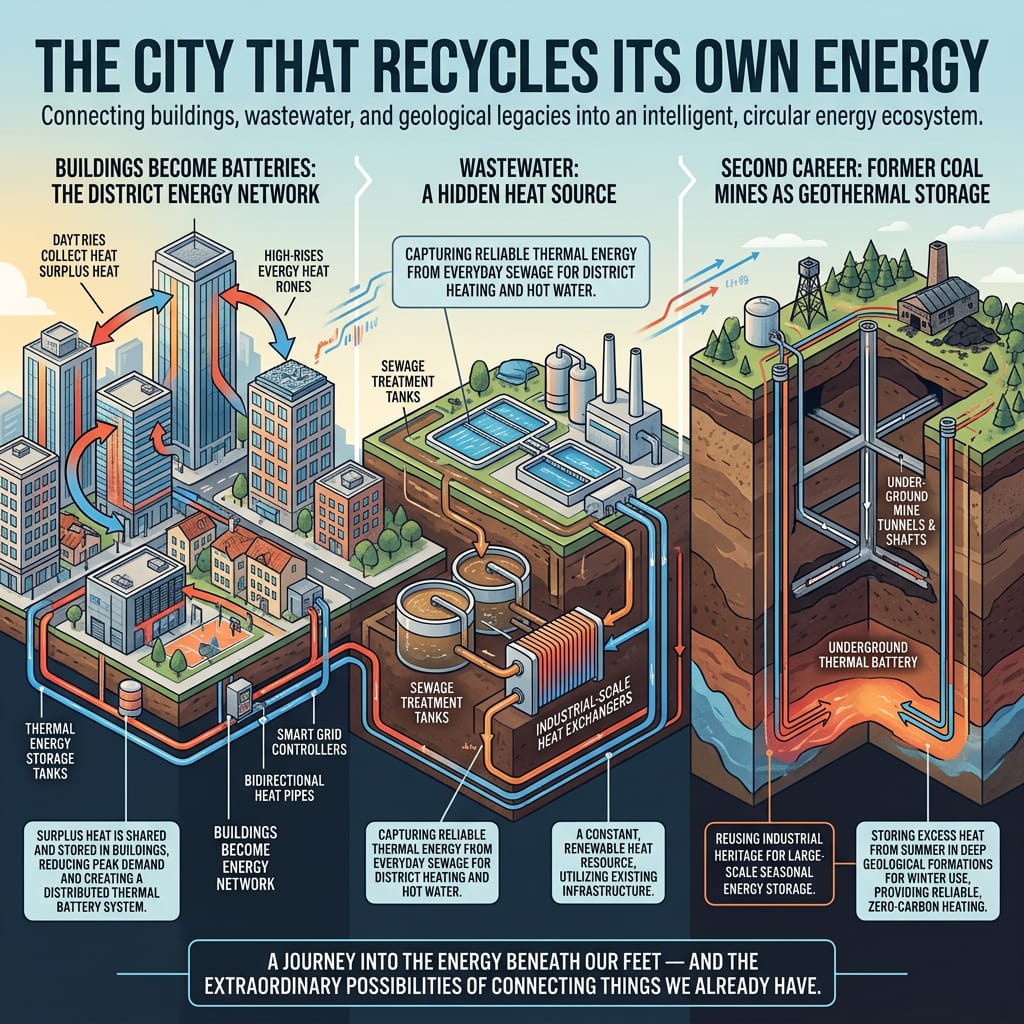
The supermarket produces excess heat while keeping the milk cold. The office building releases warmth from its computers. Nearby apartments need heating. Instead of throwing the excess warmth away, the buildings exchange it.
One building’s waste becomes another building’s resource.
The supermarket manager is delighted. The apartment residents are warm. And the neighbourhood’s heating engineer has finally found a reason to smile on Monday mornings.
Welcome to the curious world of thermal energy networks, where a building can become both a customer and a supplier. And where the most valuable energy discovery might not be a new source at all.
It might be the pipe connecting two old ones.
The Great Energy Misunderstanding
When we talk about energy, we usually talk about electricity. Solar panels. Wind turbines. Nuclear reactors. Batteries. Hydrogen.
All exciting. All important.
But much of the energy we use in buildings goes into something far less glamorous: keeping ourselves comfortable. Heating rooms, warming water, cooling offices and running refrigerators. Industry adds its own substantial need to keep processes at the right temperature.
And while we worry about generating enough electricity, enormous amounts of heat are being released into the environment.
A supermarket refrigerator removes heat from its interior and rejects it elsewhere. A computer turns most of the electricity it consumes into heat. A warm shower sends thermal energy down the drain. An industrial process may release hot water or exhaust gases.
Not all this heat can be economically recovered. Some is too cool, too distant or too intermittent. But some of it is surprisingly useful.
We have spent generations treating excess heat as a nuisance.
What happens when we start treating it as a resource?
Meet the Fifth-Generation Heating Network
Traditional district heating is relatively straightforward. A central plant heats water, which travels through insulated pipes to buildings. The buildings use that heat, and cooler water returns to the plant.
Think of a giant communal radiator.
Fifth-generation district heating and cooling networks work differently. Instead of distributing very hot water from one large source, they commonly circulate water at temperatures closer to those of the surrounding ground.
Buildings use heat pumps to raise the temperature when heating is required, or transfer unwanted heat into the network when cooling is needed. The network can connect multiple thermal sources and stores, including the ground, industrial waste heat, commercial buildings and thermal storage. adgeo.copernicus.org
This changes the relationship between buildings. A conventional heat customer mainly receives energy. In a fifth-generation network, that same customer may also supply useful heat.
Imagine a neighbourhood where the supermarket, office block, swimming pool and apartment building all belong to the same thermal club.
Membership requirement?
Bring your own pipes.
A Simple Neighbourhood Example
Let’s say the supermarket’s refrigerators remove heat from their refrigerated displays. Ordinarily, that heat is released to the outside air or reused within the store. But our imaginary supermarket is connected to a thermal network.
The recovered warmth enters the network, where another building’s heat pump can use it to provide space heating or hot water. Meanwhile, an office building requires cooling. It, too, can transfer heat to the network.
The apartment building needs warmth. The office wants less warmth.
For once, two neighbours have complementary complaints.
And the engineer can do something useful about both.
Of course, the heat does not simply travel from a refrigerator into someone’s bathtub. Heat exchangers, pumps, controls and appropriate temperatures are needed. But the underlying idea is remarkably simple: why throw away useful heat while another building is paying to produce it?
A Real City, Real Coal Mines, and a Rather Unexpected Comeback
Travel to Heerlen, in the southern Netherlands. For generations, coal mining shaped the region. The mines brought employment, industry and prosperity, but also environmental and economic consequences.
Eventually, the coal mines closed. The underground workings remained.
Normally, that might be the end of the story.
But engineers looked at those abandoned mine passages and saw something different.
Water. Underground space. Thermal energy.
An opportunity.
The Mijnwater network uses the region’s former mining infrastructure as part of a fifth-generation heating and cooling system. Buildings can exchange surplus heat, while the mine water provides a thermal resource and storage capacity for the wider network. Publications Office of the EU
What makes the concept particularly interesting is that buildings are not merely passive consumers. They can contribute energy to the system.
The old mine has found a new profession. Instead of extracting carbon from underground, it helps manage warmth above ground.
Quite a career change.
And unlike some ambitious energy concepts, this one is not waiting for a laboratory breakthrough. It already operates. There are challenges, naturally: networks must be built, heat pumps installed, water managed and customers connected. But the operating system demonstrates that the principle can work. Mijnwater
Perhaps the most satisfying part is this: the mine did not have to become only a reminder of yesterday’s energy economy.
It became part of tomorrow’s.
Vancouver
The City That Found Energy in Its Sewers
Now we travel across the Atlantic to Vancouver, Canada. A city surrounded by spectacular scenery, mountains and water. And beneath the streets, something considerably less scenic.
Sewage.
Not the first place most people would look for an energy breakthrough. Yet wastewater from showers, washing machines, kitchens and other activities still contains heat. Ordinarily, that warmth travels into the sewer system. Vancouver decided to recover some of it.
Its False Creek Neighbourhood Energy Utility began operating in 2010, using sewage heat recovery to supply heating and hot water to buildings. It offers another example of recovering urban heat, although its distribution system differs from the fifth-generation networks described above. City of Vancouver
In October 2025, the city announced the completion of a major energy-centre expansion. At that point, the network supplied 47 buildings, serving more than 10,000 residents, a university, a community centre and businesses. Its additional sewage-to-water heat pumps deliver more than three units of thermal energy for every unit of electricity they consume. City of Vancouver
Does that mean they have invented a machine that creates energy from nothing?
Unfortunately, no.
The heat pump uses electricity to move heat from a lower-temperature source to a higher-temperature destination. The delivered warmth includes both that recovered heat and the energy supplied to operate the machine.
Think of a refrigerator running with a different purpose. A refrigerator removes heat to keep your vegetables cold. A heat pump moves heat to keep your living room warm.
The same family of physics, with rather different ambitions.
Vancouver’s approach is especially appealing because the wastewater system already exists. The city is recovering something that was literally disappearing down the drain.
For once, flushing money down the toilet has acquired a completely different meaning.
The Buildings That Behave Like Batteries
Now for a curious thought. A battery stores energy for later use. Could a building do something similar?
Not by storing electricity in its walls, but by storing thermal energy.
A concrete structure has thermal mass. Water tanks can store heat. Underground systems can retain thermal energy for extended periods when geology and design permit. Buildings can sometimes be heated or cooled slightly ahead of demand, within safe and comfortable limits.
Consider an office building. During the afternoon, abundant solar electricity may be available. The building’s cooling system runs while electricity is plentiful. Its structure and dedicated thermal storage may help maintain comfortable temperatures later, reducing the need for cooling during peak hours.
The building has effectively shifted some energy demand through time.
It is not a literal electrical battery. You cannot plug your phone into a warm concrete wall.
Well, you can try.
The phone will be unimpressed.
But from the energy system’s perspective, flexible heating and cooling demand can provide some of the same benefits as storage. And when multiple buildings share a network, those opportunities can become more interesting.
What About Summer Heat in Winter?
Here’s another rabbit hole. Suppose a district produces excess heat during summer. Could we store it until winter?
Sometimes, yes.
Seasonal thermal energy storage can use water reservoirs, borehole fields, underground aquifers or other appropriate geological and engineered systems. Heat is stored over weeks or months and recovered when needed.
Imagine a neighbourhood using summer solar heat to help warm buildings during colder months. Or storing winter cooling potential for use during summer.
The idea is attractive.
But keeping energy underground is not as simple as placing leftovers in the freezer. Heat spreads. Groundwater can move. Geological conditions matter. Storage takes space and money. And the recovered temperature may still require a heat pump.
Seasonal storage works best where the local environment, demand and system design fit together. The underground world is not an unlimited, free battery.
It has terms and conditions.
And geology writes the small print.
The Less-Walked Paths
Five Places Worth Looking
Once we stop thinking only about electricity generation, unexpected opportunities appear.
Supermarkets as Thermal Neighbours
Refrigeration systems continuously remove heat from chilled spaces. Suitable installations can recover that heat for store heating, hot water or, where infrastructure permits, neighbouring buildings.
The challenge is matching supply with demand. A supermarket may produce useful heat throughout the year, while nearby residents need much more heating in winter than summer. Thermal storage and networks can help close that gap.
Data Centres as Heat Suppliers
A data centre converts much of its electricity consumption into heat. That heat must be removed to keep computers operating reliably. Where suitable cooling systems, heat pumps and nearby heat networks are available, recovered data-centre heat can potentially serve other buildings.
The complications include low heat temperatures, continuous cooling requirements, electricity consumption, financial agreements and the location of customers.
A data centre surrounded by buildings that need heat is a different proposition from one standing alone in a remote industrial park.
Once again, geography has a vote.
Swimming Pools as Thermal Partners
Swimming pools require significant energy to maintain comfortable water and indoor conditions. They may benefit from nearby waste-heat sources or district heating networks. Large public facilities can also sometimes adjust their heating or cooling schedules to help balance demand.
The swimming pool does not need to become a power station.
It simply needs to become a better neighbour.
Underground Railways and Tunnels
Underground transport systems release heat from trains, braking, electrical equipment and passengers. Some cities are investigating or using systems that recover heat from tunnels and related infrastructure.
The challenge is locating usable heat sources, collecting the energy safely and connecting it to buildings that can use it.
Even an underground station can have an unexpected second job.
Moving people through the city.
Sending heat next door.
The Ground Beneath Ordinary Streets
Not every community has an abandoned mine or an industrial furnace. But many have ground that can exchange heat with properly designed ground-source systems.
Ground-source heat pumps and shared ground-loop networks can provide heating and cooling, sometimes with thermal balancing between buildings. These installations are not suitable everywhere. Drilling costs, soil conditions, groundwater rules and building density all matter.
But the opportunity can exist without spectacular geological activity. The ground beneath a car park may not look particularly exciting.
Neither did the sewer.
But Who Pays for the Pipes?
And here the investor returns. You remember the investor. The one who was suspicious of the ocean eating expensive machinery.
This time, the ocean is innocent.
The investor looks at a diagram of the neighbourhood thermal network.
“So we dig up the streets?”
“Yes.”
“Install pipes?”
“Yes.”
“Connect buildings?”
“Yes.”
“Add heat pumps, controls and storage?”
“Quite possibly.”
“And coordinate everyone involved?”
Ah. Now we have reached the truly challenging technology.
Human cooperation.
Building a thermal network requires more than clever engineering. It requires customers willing to connect, sufficient heat demand, suitable distances, reliable ownership arrangements, investment and long-term operation.
A wonderful heat source three kilometres away may not be economically attractive if only two small buildings need it. An excellent district heating design can fail commercially if too few customers join.
And a network built around one industrial source may face difficulties if that factory closes. Waste heat is not a guaranteed perpetual resource. Even a data centre might change its cooling technology, reduce operations or relocate.
That creates an interesting paradox. The city must think collectively to make the system efficient. Yet individual building owners must see a good reason to participate.
The pipe is easy to draw.
The business agreement may take longer.
Smart Cities Need Smart Boundaries
Modern thermal networks often rely on sensors, monitoring, forecasts and automated controls. Algorithms can predict building demand, coordinate heat pumps and help determine when to store or recover thermal energy. Artificial intelligence may improve some of these decisions.
But an automated network also needs reliable safeguards. What happens when a sensor fails? When electricity prices suddenly rise? When a building stops supplying expected heat? When predicted demand differs from reality?
A clever system must also be understandable, maintainable and capable of safe operation during failures. The goal should be better management of useful energy.
A city that shares heat should not also share every technical failure.
Some boundaries are worth keeping.
The Real Revolution May Be Cooperation
Energy discussions often sound like sporting events. Solar versus wind. Nuclear versus hydrogen. Batteries versus everything else.
But perhaps those arguments overlook something important. A city’s energy system doesn’t need one winner.
It needs many parts that work together.
Electricity powers heat pumps. Heat pumps upgrade low-temperature energy. Buildings exchange heat to meet heating and cooling needs. Thermal storage helps balance supply and demand. Renewable electricity can reduce the emissions associated with operating the system, while digital controls help coordinate it.
And existing infrastructure may provide opportunities nobody originally imagined. A coal mine can become a thermal resource. A sewer can provide useful heat. A supermarket can supply its neighbours. A data centre can become part of the heating system.
The most interesting innovation may not be the invention of another machine. It may be recognising that separate machines can form a more useful system together.
That is a different kind of intelligence.
Not necessarily artificial.
Just connected.
The Rabbit Finds a Pipe
Imagine our rabbit returning from its earlier expedition through the world of energy. It has inspected wave machines battered by storms, hydrogen installations with colourful labels, geothermal drilling rigs and experimental ocean power systems.
Its notebook is full. Its boots are muddy.
Its backpack is heavier than expected.
Then, while wandering through an ordinary street, it notices a small pipe emerging from a supermarket. The pipe disappears underground. Curious, the rabbit follows its route.
Past an office building.
Under a small park.
Around an apartment complex.
And into a central thermal exchange station.
There are no spectacular turbines. No enormous cooling towers. No giant new power plant. Just pumps, valves, heat exchangers, sensors and a few people making sure everything works.
The rabbit opens its notebook.
“Where does the energy come from?”
The engineer smiles.
“Several places.”
“Who owns it?”
“Different participants.”
“And who uses it?”
“Whoever needs the heat, provided the system can deliver it.”
The rabbit thinks for a moment. Then writes one final sentence:
Perhaps the future of energy isn’t simply about finding more. Perhaps it’s about making better use of what we already have — together.
And somewhere beneath the city, the water keeps flowing.
Quietly.
Without making headlines.
Which, for once, might be exactly what progress looks like.
Sources and further reading
The story combines an imagined neighbourhood with documented technologies and operating projects.
- Mijnwater, Heerlen — fifth-generation heating and cooling using former mine infrastructure.
- Vancouver’s wastewater heat recovery expansion — the October 2025 expansion serving 47 buildings.
- IEA: Renewables in District Energy (June 2026) — opportunities, economics and limitations of modern thermal networks.
- IEA District Heating and Cooling research — thermal storage, heat recovery and connected energy systems.
What makes this a particularly interesting follow-up to the previous AITroT article is the change of perspective.
The first article asked: Can we harvest the energy?
This one asks: Why are we throwing so much of it away?
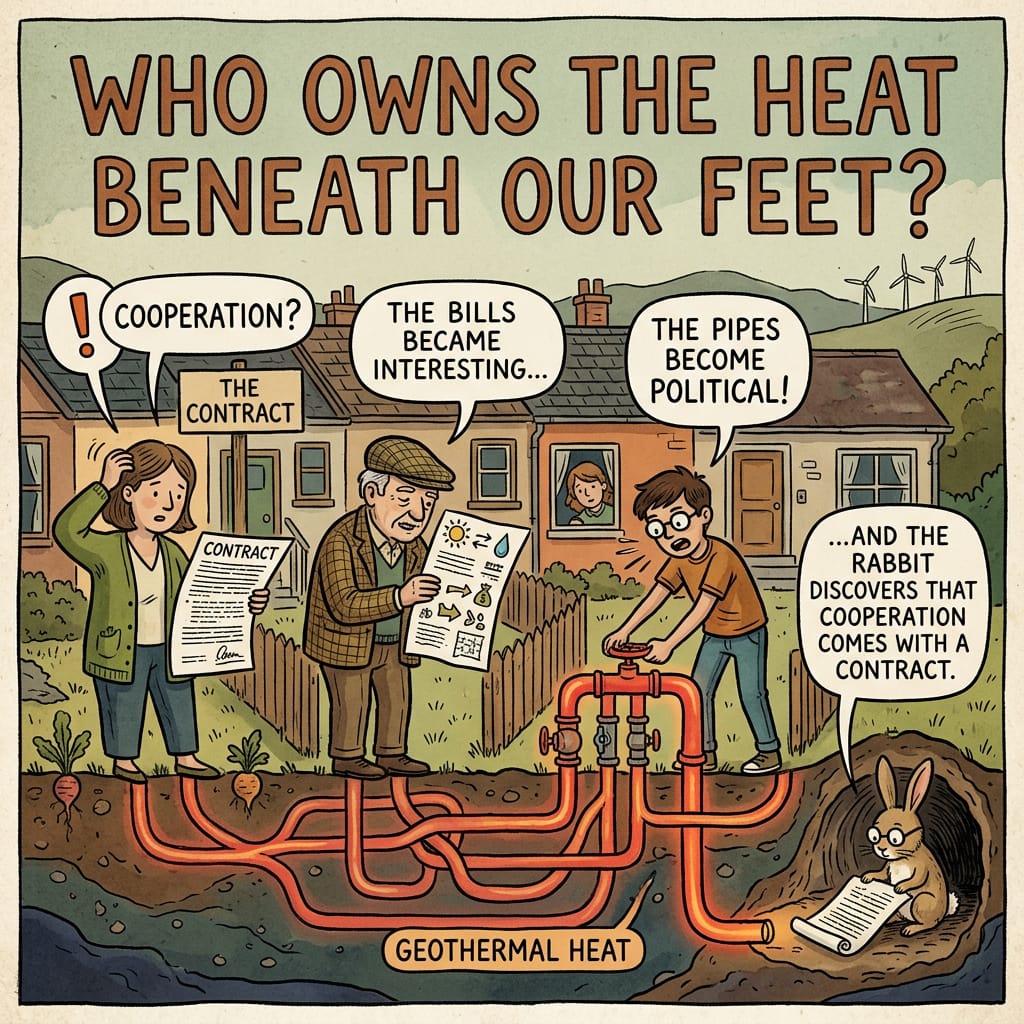
And there’s a third rabbit hole waiting: Who owns the energy flowing between buildings, who pays for it, and who benefits?
Because the moment buildings become energy partners, engineering meets economics, ownership and community. And that might be an even more interesting story.
Text with help of openAI’s ChatGPT Laguage Models & Fleeky – Images with help of Picsart & MIB
AITroT — Exploring the technologies of tomorrow, the infrastructure beneath today, and the unexpected connections between them.
Free Energy Explorer GPT
Explores actual free energy inventions and discoveries.

Thank you for questions, shares and comments!
Share your thoughts or questions in the comments below!