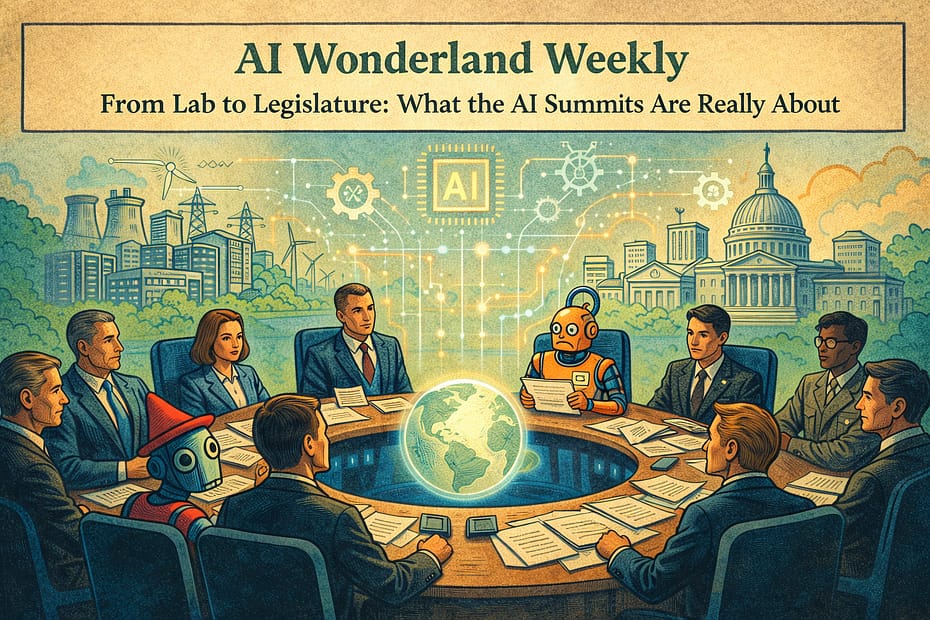
Beyond the Illusion of Neutral Technology
Oh… this is a strong one.
We’ll keep it thoughtful, not alarmist. Clear-eyed, not dramatic.
For a long time, AI was framed as neutral.
A tool.
A research field.
A productivity engine.
That framing is dissolving.
The deeper AI moves into robotics, autonomous systems, defense logistics, and strategic infrastructure, the harder it becomes to pretend it exists outside geopolitics.
Technology does not sit above power structures.
It reshapes them.
AI Is Becoming Strategic Capital
We’re witnessing a subtle but profound shift.
AI capability is no longer measured only in model benchmarks.
It is measured in:
- chip supply chains
- robotics manufacturing capacity
- access to rare earth materials
- data center energy stability
- integration into defense systems
When a nation controls advanced robotics and autonomous systems, it gains leverage — economically and militarily.
This isn’t new in history.
But the speed is.
Robotics are The Physical Layer of AI
Software influences information.
Robotics influences territory
Once AI moves from language models into autonomous drones, industrial automation, logistics networks, and battlefield systems, alignment becomes a geopolitical matter.
The question stops being: “Who has the best model?”
It becomes: “Who has operational integration at scale?”
Dominance in robotics is not symbolic. It’s tangible.
The Illusion of Pure Competition
There’s a narrative that this is simply a race.
But what’s emerging is more complex.
Countries are:
- collaborating on safety frameworks
- competing on compute
- aligning strategically
- hedging alliances
AI is creating new power blocs, but also new dependencies.
Energy grids depend on AI optimization.
Defense systems depend on AI logistics.
Manufacturing depends on robotic automation.
Interdependence increases even as rivalry intensifies.
The Warfare Question
We cannot ignore it.
Autonomous weapons, AI-driven targeting, predictive defense systems … these are no longer speculative.
But there is another dimension often overlooked:
AI reduces reaction time.
And reduced reaction time changes the nature of escalation.
When systems respond faster than humans deliberate, governance becomes critical.
The risk is not just capability.
It is miscalculation.
Not Fear … Responsibility
The conversation does not require panic.
It requires maturity.
AI dominance is not merely about who builds the fastest systems.
It’s about who builds:
- resilient governance
- ethical constraints
- strategic stability
- diplomatic frameworks
Power without structure destabilizes.
Power with coordination can stabilize.
The Real Question
The issue is not whether AI will influence geopolitics.
It already does.
The question is whether alignment will emerge through:
- cooperation
- deterrence
- economic interdependence
- or fragmented technological blocs
History shows that transformative technologies reshape global order.
AI may be doing so more quietly than expected … but no less profoundly.
Wonderland Takeaway
AI is no longer just intelligence.
It is infrastructure.
It is robotics.
It is logistics.
It is strategic capability.
The world is not just debating how smart machines will become.
It is negotiating how power will be distributed.
And that conversation has only just begun.
Text with help of OpenAI’s GPT language models , Images with help of DALLE, openai chatbox, DALLE-2 , Fleeky & MI
Thank you for questions, shares and comments!
Share your thoughts or questions in the comments below!