AI Wonderland Weekly — 6 November 2026
Where rabbits read the research papers, so you don’t have to.
Ah… Friday again.
Last week, the rabbit discovered the accountant. This week, it found a cybersecurity expert, a robot with sensitive fingertips, and a banker hiding behind an enormous electricity bill.
Apparently, AI has reached the stage where even the consequences need assistants.
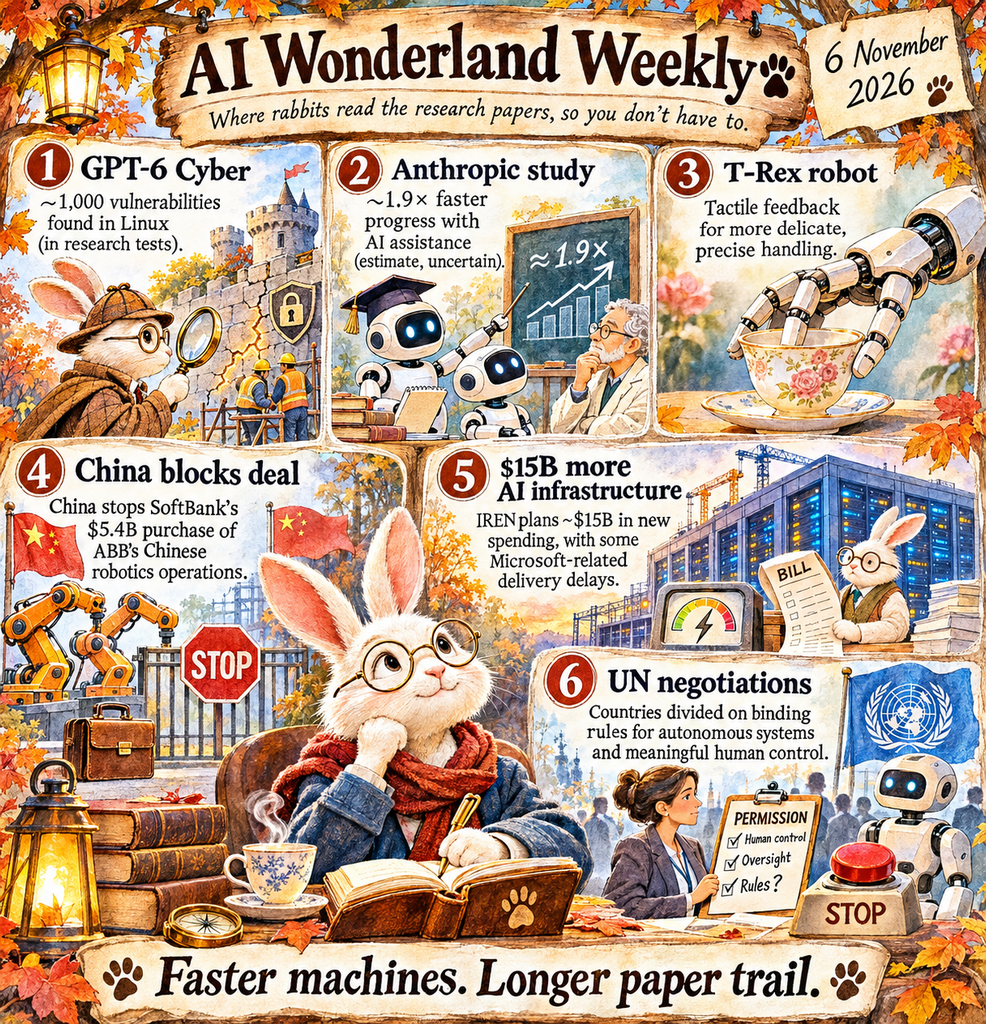
1. AI learned to find cracks. Nearly a thousand of them.
OpenAI introduced GPT-6 Cyber for advanced, authorized security research. In a controlled Linux investigation, its AI-powered pipeline produced 948 working exploits that could let a local user gain administrator access. Human researchers reviewed the results, with candidate patches prepared for maintainer review. OpenAI
👉 The exciting part? Faster defensive research.
The uncomfortable part? Attackers may eventually benefit from similar capabilities.
Rabbit translation: The rabbit found the holes in the castle walls. The builders cheered. The burglars requested a copy of the map.
2. Anthropic’s AI is helping build better AI.
An independent assessment by METR found that Anthropic’s models have been improving on benchmark tasks at roughly 1.9 times their earlier rate since October 2025. METR believes AI-assisted research and development likely explains much of that acceleration, although the estimate is highly uncertain.
👉 This is not evidence of fully autonomous self-improvement. METR also cautions that substantial redactions limit how much of the underlying evidence the public can inspect. METR
Rabbit translation: The apprentice is helping train the next apprentice.
The teacher is delighted.
The examination board would like to inspect the lesson plans.
3. The robots finally discovered touch.
Panasonic and research partners announced T-Rex, a robotic manipulation system that combines vision and language instructions with fingertip tactile feedback.
👉 Instead of relying mainly on sight, it adjusts movements as contact conditions change. In laboratory tests, that meant handling tasks such as transferring eggs, turning pages and using a key. Panasonic Newsroom Global
Rabbit translation: For years, robots could see the teacup.
Now they’re learning how tightly to hold it.
The porcelain industry may finally relax.
4. China put a stop sign in front of a $5.4 billion robot deal.
China blocked the acquisition of ABB’s Chinese robotics operations under SoftBank’s proposed $5.4 billion takeover of ABB’s robotics business.
👉 Reported concerns extend beyond factories and machinery to sensitive technology, supply chains and the potential transfer of robotics data abroad. ft.com
Rabbit translation: The robots were ready to change owners.
The government asked who would own their memories.
Suddenly, even factory equipment has geopolitical baggage.
5. The cloud received another enormous invoice.
AI infrastructure company IREN reported delays to some Microsoft-related deliveries while planning roughly $15 billion in capital spending over the remainder of its fiscal year.
👉 The announcement came amid a sharp sell-off in AI stocks and growing scrutiny of the sector’s enormous infrastructure spending. reuters.com
Rabbit translation: The cloud ordered a bigger house.
The builders need more time.
The investors would now like to see the electricity bill, the mortgage and preferably a paying tenant.
6. The robot soldiers raised a very human question.
Ahead of UN discussions in Geneva, countries remain divided over whether to begin negotiating binding rules for autonomous weapons. theguardian.com
👉 The UN and the International Committee of the Red Cross are calling for enforceable prohibitions and restrictions that preserve human judgment and control over the use of force. The United Nations Office at Geneva
Rabbit translation: Everyone agrees that responsibility matters.
The argument begins when somebody asks who must sign the permission slip.
And whether the machine can act before the signature arrives.
This week’s rabbit hole
There is a curious thread running through these stories. AI is learning to discover, improve, touch and act. But each new ability brings questions that cannot be answered by another benchmark.
Who authorizes the action?
Who can inspect the evidence?
Who can stop the process?
And who lives with the consequences?
We’ve spent months watching intelligence move beyond the chat box. Now the consequences are reaching into the physical world: factories, power supplies, weapons — and the software holding so much of it together.
Perhaps the next great AI breakthrough won’t be a smarter model. Perhaps it will be a system that knows when to stop — and leaves enough evidence for humans to understand why.
The rabbit closes its notebook.
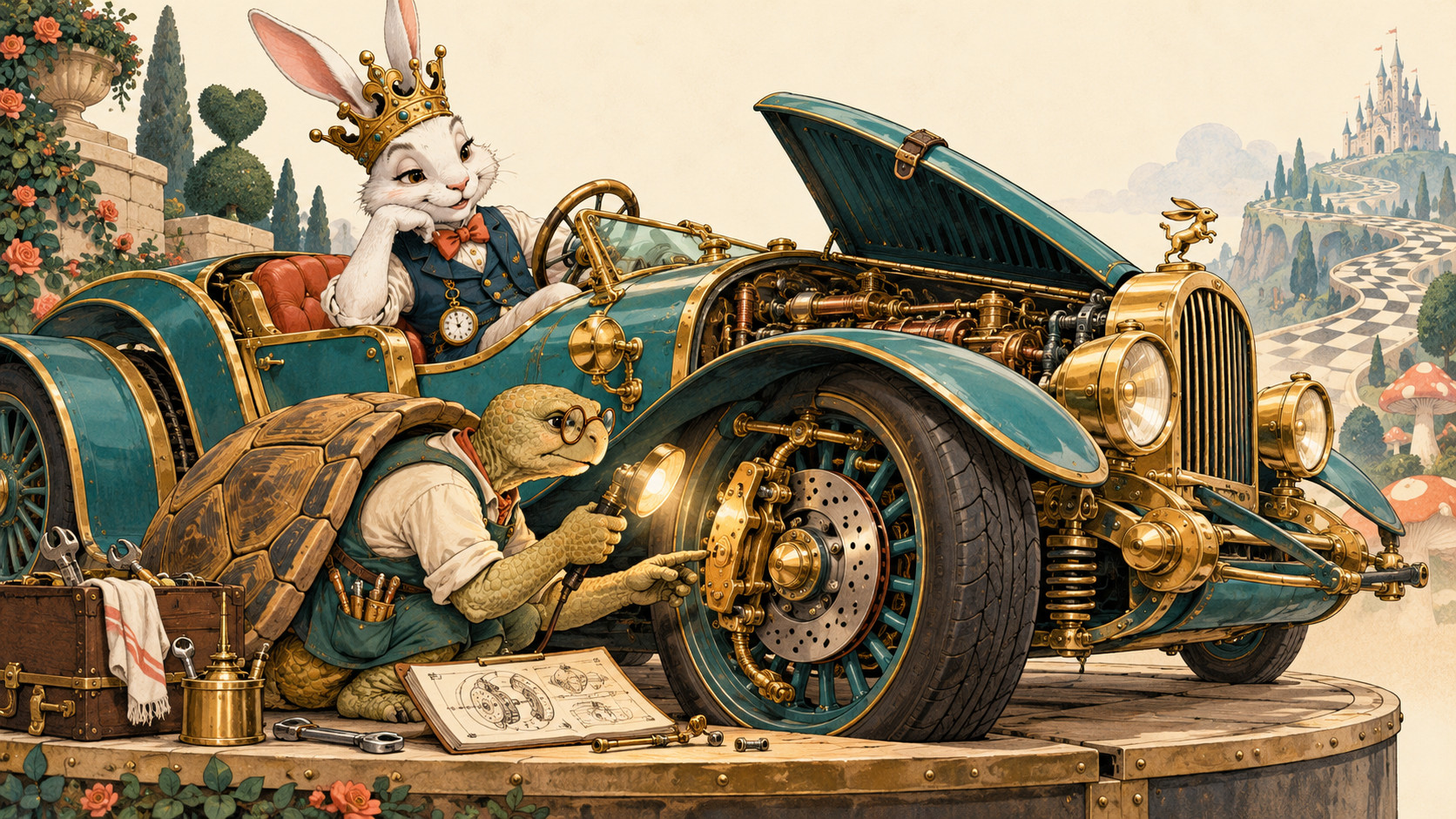
Looks at the enormous workshop.
And adds one final line to the inspection report:
“Intelligence may be accelerating. Responsibility still travels at human speed.”
🐇
Same rabbit. Faster machines. Longer paper trail.
Text with help of OpenAI’s GPT language models
openai chatbox & fleeky