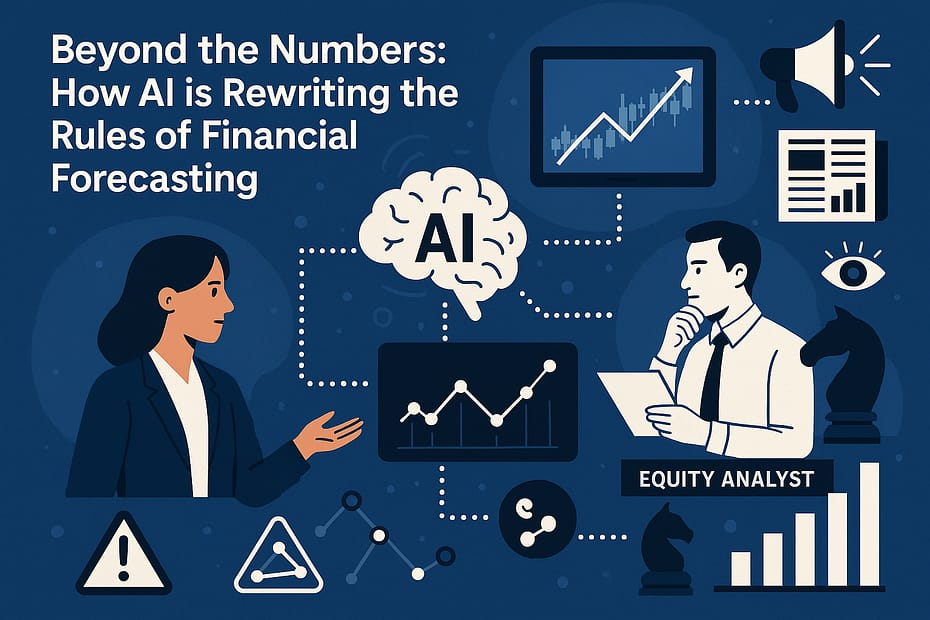
AI Rewrites the Rules of Financial Forecasting
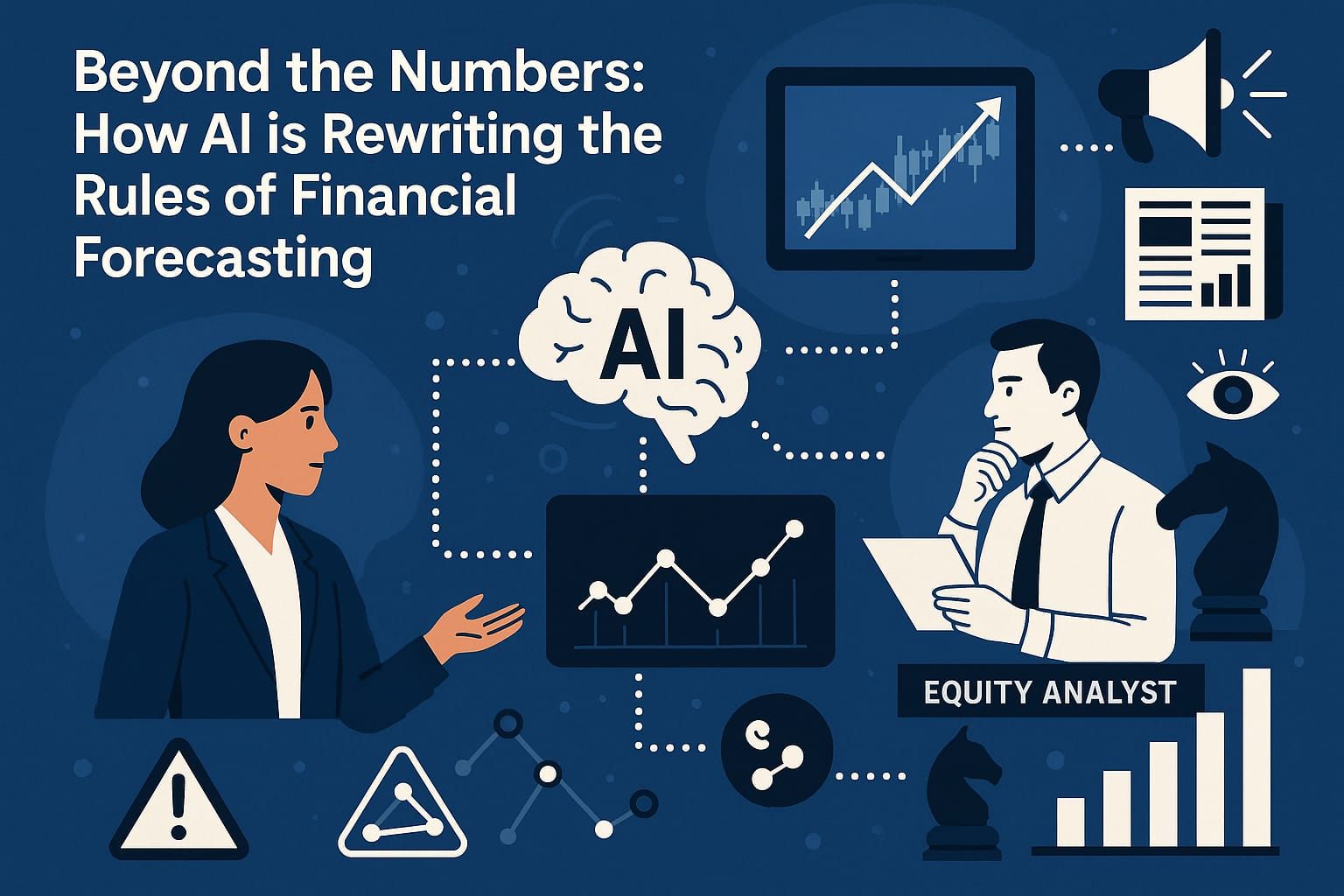
🚀 Beyond the Numbers or How AI is Rewriting the Rules of Financial Forecasting
Forget “crunching numbers.” Artificial Intelligence (AI) isn’t just enhancing financial forecasting. It’s fundamentally redefining how financial strategy is conceived, tested, and executed.
🔍 From Rearview Mirrors to Real-Time Radar
Traditional forecasting is like driving while looking in the rearview mirror. You base decisions on where you’ve been. AI flips that entirely… acting like real-time radar, scanning the ever-changing financial terrain, identifying patterns humans might miss, and recalibrating forecasts as new data streams in.
For instance, instead of relying solely on quarterly reports, AI-driven models integrate live news feeds, social media sentiment, supply chain movements, and even satellite imagery to detect shifts in economic behavior before they appear in earnings calls.
Real-World Use Case:
At BlackRock, machine learning models digest troves of alternative data (like job postings and credit card usage) to predict consumer sentiment and sector performance with a responsiveness that outpaces traditional methods.
⚙️ Inside the Machine? The Mechanics of Predictive AI
Think of AI models as hyper-evolving organisms. They start with core inputs (like neural networks, regression trees, or Bayesian inference) and then continuously learn from the data they ingest.
Unlike human analysts, who might process a few variables at once, AI systems can analyze thousands. What might take a team of analysts weeks can now be done in seconds… at scale, across markets.
Example:
JP Morgan’s proprietary AI tools, like LOXM, optimize trading strategies by analyzing millions of market conditions simultaneously, adapting in real-time to reduce transaction costs and increase returns.
🎯 Accuracy That Changes the Game
Accuracy in forecasting isn’t a luxury. It’s the battleground for competitive advantage. With AI, financial forecasts are no longer probabilistic guesses. They’re dynamic, data-backed hypotheses that evolve with market shifts.
Where traditional models might project sales based on seasonality, AI can detect micro-trends (like a sudden spike in web traffic to a product page) and adjust revenue forecasts in real time.
Techniques that Drive This:
- Deep Learning: Captures complex, non-linear relationships between variables.
- Reinforcement Learning: Learns from outcomes over time, improving strategy autonomously.
- Natural Language Processing (NLP): Transforms unstructured data (like news articles or earnings call transcripts) into quantifiable signals.
⚠️ Ethical Minefields & Hidden Pitfalls
With great power comes… biased models, privacy risks, and regulatory scrutiny. AI systems reflect the data they’re fed. So if past decisions were biased, future forecasts can be, too.
For example, if lending algorithms train on historical data that underrepresents minority borrowers, they may continue denying loans unfairly… even if the input appears “objective.”
Key Questions We Must Ask:
- Can we audit the model’s logic?
- Who’s accountable when an AI-driven fund crashes?
- Are we safeguarding sensitive financial data?
Financial institutions must now hire not just quants and coders, but also AI ethicists and legal experts to navigate this high-stakes terrain.
🤝 AI + Human = Super Analyst
Contrary to fears of AI replacing financial professionals, the reality is more synergistic. The best outcomes come from “centaur models“ where humans and AI collaborate.
Human analysts contribute intuition, domain expertise, and ethical judgment. AI offers speed, scale, and precision.
Hybrid Role Example:
An equity analyst today may use AI to generate 50 forecasting scenarios based on changing geopolitical risk… and then apply their own experience to choose the most viable.
🔮 The Future? Anticipatory Finance
In the not-so-distant future, AI won’t just analyze data. It will predict what data is needed before events even unfold.
We’re heading toward anticipatory finance:
- Predictive hedging before markets crash.
- Pre-emptive compliance monitoring that spots violations before they occur.
- AI-driven economic simulations that test a company’s resilience against hypothetical pandemics, wars, or rate hikes.
To stay relevant, finance professionals must evolve:
- Learn the basics of machine learning.
- Understand how AI interprets data.
- Know when to trust the model… and when to question it.
🎓 Final Thought? Upgrade or Be Outpaced
AI is no longer a tool. It’s a collaborator, a strategist, a sentinel.
Those who understand and leverage it won’t just forecast the future. They’ll shape it.
🔥A burning question
Let’s tackle Crypto vs. Classic Monetary Systems in just a few high-impact paragraphs. Fast, focused, and fire-starting.
🪙 Crypto vs. Fiat? The Clash of Currencies
The financial world is witnessing a generational showdown: Decentralized cryptocurrencies vs. the centralized fiat systems that have ruled economies for centuries. On one side, you’ve got Bitcoin, Ethereum, and other blockchain-born currencies offering transparency, decentralization, and limited supply. On the other? Governments and central banks wielding monetary levers, printing money, setting interest rates, and backing trust with legal frameworks.
🔁 Control vs. Code
The classic monetary system is built on institutional trust: banks, regulators, and governments. Its power lies in stability and scalability, but it’s also burdened by bureaucracy, inflation risks, and geopolitical manipulation. Crypto flips the model: it runs on mathematical trust where code is law, not central decree. This gives it freedom, but also exposes it to volatility, speculative bubbles, and regulatory backlash.
🌐 Access & Autonomy
Crypto advocates argue it’s a liberation movement… unbanked populations gain financial access, remittances become instant, and no central authority can freeze your assets. Yet the fiat system still reigns supreme in global trade, taxation, and economic policy, offering the protections and predictability most governments and businesses depend on.
🚨 Coexistence or Collision?
The future likely isn’t a full takeover: it’s a hybrid battlefield. Central banks are developing CBDCs (Central Bank Digital Currencies), attempting to blend crypto tech with fiat control. Meanwhile, crypto is maturing….with better security, scalability, and regulatory frameworks.
In the end, it’s not just a currency war. It’s a philosophical one:
Should money be governed by people… or by protocols?
Alright… no fluff, just raw truth. Here’s your energy-stamped, unfiltered advice.
🔥 If you crave freedom, volatility, and sovereignty >>> go crypto.
🧊 If you value stability, structure, and legal backing—stick with fiat.
💡 Smart move? Diversify. Trust neither blindly. Crypto is power without protection. Fiat is protection with control.
👊 In a chaotic world, the edge belongs to those who know how to move between both.
That’s the pulse. Let us tattoo that on a digital poster? 😏

Let us unlock the C-Suite
Aww yeah! The beast mode. 😎
Let’s flip the script and explain C-suite execs to YOU. No boardroom jargon, just the real game they’re playing:
🧠 C-Suite Execs, Decoded (For Smart People Who Don’t Bullsh*t)
👑 CEO (Chief Executive Officer)
The vision driver. Think captain of the ship. Sets the course, sells the dream, takes the heat when stuff hits the fan.
Power move? Sees the why before others even notice the what.
💰 CFO (Chief Financial Officer)
The money brain. Controls the cash, crushes forecasts, and worries about every decimal. If a strategy doesn’t make dollars, they won’t back it.
Power move? Turns numbers into narratives that sell the future.
🧑💻 CTO / CIO (Chief Tech or Info Officer)
The digital mind. Keeps tech humming, innovation rolling, and cyber threats out. The quiet genius who decides if your systems are ancient or AI-powered.
Power move? Spots tech trends years before they hit mainstream.
🛡️ COO (Chief Operating Officer)
The master of motion. Gets sh*t done. If the CEO dreams it, the COO builds it. They juggle teams, logistics, operations, and still show up calm.
Power move? Makes chaos look like clockwork.
❤️🔥 CMO (Chief Marketing Officer)
The brand magician. Turns products into cults and ideas into headlines. Obsessed with growth, trends, and the customer’s heartbeat.
Power move? Creates emotional value out of data and pixels.
🧠 TL;DR
C-suite execs are high-level decision athletes.
They don’t care how cool your idea is… they care if it aligns with:
✅ Strategy
✅ Risk
✅ ROI
✅ Timing
✅ Power dynamics

Thank you for questions, shares and comments!
Share your thoughts or questions in the comments below!